


Another reporter recently privately criticized me for, in an opinion piece on the transit strike, using the phrase “Whose side are you on?”
I shrugged it off at the time—reporters have opinions, too, and I figured my colleague wasn’t aware of my reference to the labour song, “Which side are you on?” But yesterday my American friend Michelle was musing about the song, which prompted me to follow up. If nothing else, running through the history of the song is fun; maybe it also sheds some light on our poor knowledge of labour history.
To back up, “Which side are you on?” was written by Florence Reece in 1931, in the midst of a brutal crackdown on the United Mine Workers, which were then organizing the coal mines of Kentucky:
In 1931, coal miners in Harlan County were on strike. Armed company deputies roamed the countryside, terrorizing the mining communities, looking for union leaders to beat, jail, or kill. But coal miners, brought up lean and hard in the Kentucky mountain country, knew how to fight back, and heads were bashed and bullets fired on both sides in Bloody Harlan.
It was this kind of class war — the mine owners and their hired deputies on one side, and the independent, free-wheeling Kentucky coal-miners on the other — that provided the climate for Florence Reece’s “Which Side Are You On?” In it she captured the spirit of her times with blunt eloquence.
Mrs. Reece wrote from personal experience. Her husband, Sam, was one of the union leaders, and Sheriff J. H. Blair and his men came to her house in search of him when she was alone with her seven children. They ransacked the whole house and then kept watch outside, ready to shoot Sam down if he returned.
One day during this tense period Mrs. Reece tore a sheet from a wall calendar and wrote the words to “Which Side Are You On?” The simple form of the song made it easy to adapt for use in other strikes, and many different versions have circulated.
The tune is usually said to be an old Baptist Hymn, “Lay the Lily Low,” but the British folklorist, A. L. Lloyd, points out its similarity to that of the British ballad, “Jack Munro,” which uses “Lay the Lily Low” as a refrain.
“Which side are you on?” quickly became a staple in the union songbook. Reece, who remained a stalwart union supporter and lived into her late 80s, was recorded singing the song for the 1976 film Harlan County, USA. That documentary covers the 1973 strikes in the very same coal fields Reece wrote about 42 years earlier:

I love one of the comments on that YouTube page:
I Love this song it was wrote by my Grandmother Florence Patton Reece. She was
an inspiration to me growing up. My dad has the actual calendar that this song was wrote on in the 1930’s. Florence & Sam Reece had 10 children and my Dad is the only living one left. I hope everyone loves this song.
“Which side are you on?” hit the mainstream when the Almanac Singers—the folk group comprised of Woody Guthrie, Pete Seeger, Willard Lamplell and Lee Hays—recorded it in 1941:

Of course, the all-male Almanac Singers had to tweak the words of the song a bit—the narrator becomes the son of a coal miner, not the wife. And to my ear, there’s an underlying forlornness in the Almanac version as compared to Reece’s original (at least as reprised in Harlan County, USA), which I hear as more combative. This is all for the better—what’s great fun with this song is how it morphs through the generations depending on the audience and singer.
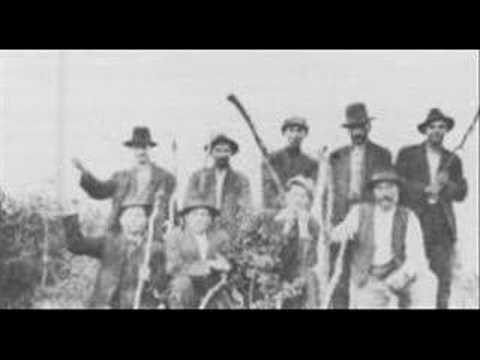
Pete Seeger would sing the song for the rest of his life—he’s still singing it. During the folk revival of the 1960s, the song takes on an almost celebratory feel which strikes me as odd; here’s Seeger’s version from (I think) his 1967 Greatest Hits album:
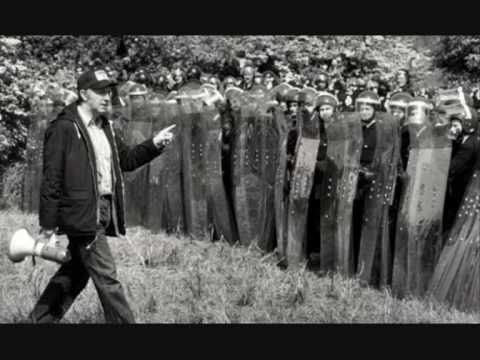
The versatility—and continued relevance—of the song comes out wonderfully in Billy Bragg’s 1987 Back to Basics, where Bragg reworks the lyrics and brings an edgy attitude to it to express anger at the union-busting Thatcher government:
In 2001, the Celtic-punk band Dropkick Murphys did a version of “Which side are you on?” for their Sing Loud, Sing Proud album. It’s interesting, and none other than Shane MacGowan was a guest vocalist for the album. I don’t know if MacGowan’s drunken slurs are in this mix or not, but it makes me just itch for a full-blown Pogues cover:

A couple of years later, the angelically voiced Natalie Merchant recorded “Which side are you on?” for her 2003 The House Carpenter’s Daughter. This version was a real surprise for me, bringing the song right back to an Appalachian spiritual, with an emotional depth that reaches right to the centre of the Earth:

This year, Ani Difranco, like Billy Bragg before her, re-writes some of the lyrics for a contemporary political purpose: to express anger at 30 years of Reaganesque economic policy and the cynicism of the Obama administration, which has sold out the progressive ideas it put forward to get elected:

But is the question, “Which side are you on?” relevant in a transit strike in Halifax? Is it fair to compare a coal miners’ strike in 1931 Appalachia to middle class workers in Canada, with its universal health care and safety net protections?
My answer to that is this: We should be striving for more. Our society is doing OK economically, with productivity and total wealth increasing every year, even in these sluggish post-financial collapse years, so why is it we are looking to reduce workers’ pay and benefits?
It occurs to me that no matter what the relative wealth of a society– whether it’s a poor-ish maritime province in 2012, or one of the wealthiest societies ever in existence, Britain in the 1980s, or Appalachia of the 1970s, or Appalachia of the 1930s or even societies with outright slavery—the antebellum American south, or classical Rome or whatever— there is always some portion of the population that absolutely hates workers. Even slaves were disparaged as lazy and slothful, of living in too plush conditions for their strata in society.
The language continues on to this day: For lots of people, such and such workers are over-paid, are lazy, are a burden to society. And since it doesn’t matter what society we’re talking about—rich, poor, even slave societies—I just understand this view to be endemic to a certain kind of person, who naturally sides with the powerful over the weak, no matter what.
So yes, I think it’s fair to ask: are you one of those people? Or do you want wealth to at least in some degree be shared by the people who actually do the productive work in society?
Which side are you on?
This article appears in Mar 8-14, 2012.

This is great and all, but wouldn’t the Kentucky Coal Miners in your example be the Transit users? lol. Those are the people with no power in this situation. Not the Union.
Great article Tim. I have read alot of your articles recently, and I commend you for the great work you have put in to it. People always will have negetavie thoughts about union workers, I was one until I started working for one. Unions fight for the rights of their brothers and sisters when they cannot fight for themselves. If everyone in society could fight for themselves against governments and employers, society would be a much different one. How many times have I heard “They fired me for no reason”? Or, “I have been working full time hours for part time pay”? It is examples like these that unions fight for. I applaud you for being a hard working reporter that puts time and energy behind what you write.
I think that the media – not just the Coast needs to think about their role in this labour struggle – was striking the right move? if we look at the goals of a strike its suppose to negatively impact the employer by loss of service or production the hit is financial- did this happen – the answer is no, in fact the reverse happened the employer gained $$$ – did ATU 508 gain public support – no the people who pay taxes for transit are not usually the users of transit, the tax payers of transit are also the voters of council members – they do not want their taxes raised and the ridership just felt used and powerless – so why did the strike happen, why has it go on for so long when it was not something that benefits ATU 508 – both sides pandered to the media and you all lapped it up – and instead of the negotiating table this played out to the public in the media- it did not allow employer and employee come to a mutually beneficial agreement to get transit back on the road – I am not saying we need to be uninformed – what I am saying is the “whose side are you own” mentality has created much of this dysfunction
very interesting article, love the music. it’s difficult to compare the two situations. i have no sides, i’m always stuck in the middle
The bus drivers are working in conditions just like those coal miners, and report after report has shown that many of them are barely scraping by paycheck to paycheck. Right now, they make 50k a year before overtime, and they need to work a lot of extra hours to get a reasonable 70k a year. The fat cats in city hall want to take that away from them, reduce them to less than 55k a year.
Don’t let them! Like the song says, “I’ll stick with the union / ‘Til every battle’s won.” Every battle is worth fighting, and the union should not give in on anything great or small. Eventually, the city will start negotiating in good faith and give the workers what they need to live in basic human dignaty.
Please read the following News 95.7 article http://www.news957.com/news/local/article/…
On Jan 24, two days after the strike vote, Coun. Barkhouse indicated on the front page of Metro News that important contract clauses in the HRM offer to ATU were omitted from a closed door presentation by senior staff to Council. Was this the work of Eddie Robar or CAO Richard Butts? On part timers and contracting out she said, “I want to see (the offer) for myself, and I want to know exactly what’s going on.” Further, “(It’s) so significant that we wouldn’t have been told that…It’s quite unbelievable that something that significant, we would have to read in the paper.” What the hell is going on here?
Given the inconvenience and harm suffered by thousands in this city, it’s vital for HRM to bargain in good faith and settle this strike. ATU has made concessions. Conclude a deal or otherwise, go to arbitration. Eddie Robar and Kenny Wilson agreed on contract language related to Rostering in the City’s last and “final” offer. If it hadn’t been altered by senior staff after negotiations, it likely would have passed. The City is prolonging this strike. The Mayor, Council, Senior Management, and CAO Richard Butts don’t rely on Transit…what do they have to lose?
A recent addition to the means that this song has been presented is the children’s book “Which Side Are You On? The Story of a song.” It is written by a native daughter of Harlan County, Kentucky George Ella Lyon.
As usual, you have it ass-backwards. The greedy ones in this case are the ATU carpetbaggers trying to grab as much from the hapless taxpayers of this city as they possibly can. The MT management are trying their best to protect the citizens from this bunch, and more power to them for doing so. It has nothing to do with coal miners or robber baron industrialists or anything other than that. After nearly 100 years, the roles have been reversed, at least when it comes to unmanageable, unproductive, entitlement-minded public sector union members who think they are the ones running the place.
Bo Gus, the union is not greedy. A union cannot be greedy. Grabbing from taxpayers? No, grabbing from overpaid city workers. Fire all the management. Let the union have full control over Metro Transit, from the bottom to the top. That will free up funds, and I trust Ken Wilson would be just as successful running Metro Transit as he currently has been doing running the union local.
Besides, the city is asking the workers to take a 20k a year pay cut. How would you like to be only making 50k to 55k a year? You simply cannot expect a person to support themself, much less a family, on 50k a year.
Who was this reporter Tim? I’d love to read something besides your skewed, biased opinionated crap. Kentucky coal miners are you freaking kidding me! I for the record am on the side of reasonable pay for reasonable work. I assume you will be singing this song till The Coast gets unionized so you can finally be free from tyranny!
I’m having a hard time trying to figure out if MRC is serious or just a troll and being ironic. Personally i would love to be making 50-55k a year. I have what i consider to be a good paying job that i went to college for and upping to 50 55 would be a 10-15k a year raise.
I’m on the public’s side on this one, Tim. Not the city’s, but definitely not the union’s. How can you compare the transit union to the Kentucky coal miners? The miners’ lives were under DIRECT THREAT simply for trying to unionize and undoubtedly worked under appallingly unsafe conditions for next to no pay. The bus drivers’ lives are not in danger, they are paid reasonably well, and safety is a major priority. Maybe “things could be better” for the bus drivers but things could be better for pretty much any occupation. I am somewhat insulted by the premise of this editorial, which asks readers “which side are you on?”: side with the union, or side with “[the] portion of the population that absolutely hates workers”.
I am in my last year at Dal and though I am lucky enough not to have accumulated any major debt, I have worked pretty much through my entire degree making just over minimum wage. My first real job was as a lifeguard, starting at about $7/hour. Through most of my post-secondary career I’ve worked as a server/bartender during the school year, making just above minimum wage plus tips. During the summers I plant trees, and this is one of the most labour-intensive jobs in North America. So please don’t insinuate that because I’m not 100% behind the union, that I “absolutely hate workers”.
It would be one thing if the strike was “sticking it to the man” and actually creating some kind of negative consequence for the municipality, but as others have pointed out, HRM has actually SAVED money as a result. There have been economic consequences for sure, but these have mostly affected private businesses, and to an even larger degree, THE ACTUAL PUBLIC, MANY OF WHOM ARE MUCH LESS WELL OFF THAN THE BUS DRIVERS. Then there is the insinuation that by supporting the union, we are supporting fairness in the workplace – the city needs to stop being greedy and pay the drivers what they’re due, right? Not that simple. The city isn’t being greedy, they’re being fiscally responsible. If they save money, they don’t get to pocket it. They just don’t have to tax THE PUBLIC as much, or can provide them with better services. Please stop trying to make it look like anyone who doesn’t support the union hates workers and promotes inequality and class warfare, because it’s not that simple at all. If this were a private sector union, the tone would be very different and I would probably be more supportive. But in this case, at the end of the day, Metro Transit isn’t trying to turn a profit, they’re just trying to cut their losses. Not AT ALL the same thing, and I would hope that you’d know that. It just isn’t reflected in your journalism at all.
One last thing – you say that “reporters have opinions, too”, but don’t you still have the responsibility to present at least a somewhat fair and balanced picture? Metro Transit managers’ salaries were discussed in detail. Why did you not once mention Ken Wilson’s salary? Does the public deserve to know only one side? The Coast used to be the paper I’d go to when I wanted the full rundown on something that was covered only marginally in other media outlets. When did this change so drastically?
I was thinking the same thing alex. This has not been one article even neutral in opinion about this transit strike. It has been been so pro union it is crazy. And it even has the feel to it to me as each article has an underlying tone of “were smarter than you and your against everything good in the world if your against the union”. The coast is not the only paper that has chosen sides, but i just want to see fair reporting on both sides of the issue.
Why aren’t The Coast’s newspaper boxes painted orange? Red doesn’t seem like the right color, but it makes more sense than blue I guess.
A couple of corrections pertaining to the annotation provided for the Almanac Singers version of the song.
1. It’s Millard Lampell (not Willard).
2. The Almanac Singers were *not* an “all Male group” … The Almanacs had a “rotating membership” that included *several* women — most notably Sis Cunningham, who would go on to found Broadside Magazine, and Bess Lomax Hawes, sister/daughter of the famous folklorists and future NEA director. While this particular recording from May of 1941 featured lead vocals by Pete Seeger, the ensemble included Lee Hays, Millard Lampell, Josh White, Sam Gary, Carol White and Bess Lomax Hawes. (*Two* women, if you’re keeping score.)