

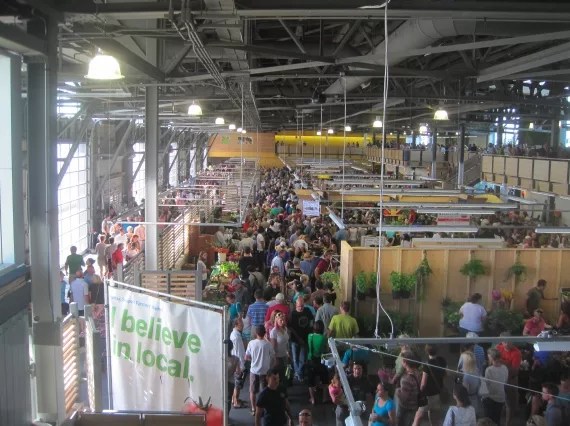
The Seaport Farmers Market will “undoubtedly” be a success, says Frank Schwartz, head of the group of citizens who invested $1.7 million to help make the market a reality. But part of that future success is based on a restructuring of the market that squeezes the investors out. It’s possible the investors have simply lost all their money.
To back up, the Seaport Market came about through a complicated financing deal. The market itself was to be run by a for-profit vendors’ co-operative, which rented the space from the Port of Halifax, a federal crown corporation. But it took about $6.5 million to renovate the old pier and warehouse. To find that money, a separate non-profit co-operative was set up to receive funds from various sources.
Schwartz, represents yet a third cooperative called the Farmers’ Market Investment Cooperative, which solicited investments through a Community Development Investment Fund—a provincial program that gives tax breaks in return for investments in local projects like the farmers’ market. About 500 people invested $1.7 million for the Seaport Market. About $1.45 million of that went as an upfront payment to the port, for a 26-year lease on the property. The balance went to professional fees.
The investors range from “rich south enders” to “just people who wanted to put $50 or $100 in,” says Schwartz, including, for disclosure’s sake, some Coast staff. That money in hand, the federal, provincial and city governments contributed an additional $5 million to make the market a reality.
Problem was, “everybody did a little less due diligence than they should have,” says Schwartz,. Especially problematic was the idea the market could turn a profit immediately. “It was unrealistic to think that a three-hour farmers’ market could immediately turn into a seven-day-a-week operation,” says Schwartz,.
With lacklustre revenues, the market fell behind on its operational costs.
Last fall, a consultant was hired to study the market and recommend changes, and Schwartz, is confident those changes will result in the market turning a profit “in five or 10 years.” But to deal with the immediate financial crisis, this week the vendors’ co-operative is turning over the lease of the facility, back to the port, which will become the direct landlord for each vendor.
However, says Schwartz,, his group was never brought into the conversation. Until this week, he’s had no communication with the port, and he’s dissatisfied with the response he’s gotten this week.
“Basically, they’re saying we’re toast,” he says. Schwartz, plans to address the investors in a meeting called for Wednesday evening, after The Coast goes to print.
Asked to comment on the port, Swartz is diplomatic. “They’re not the bad guys here,” he begins. But later he suggest the port is living up to its obligations. “They’re meeting the legal standard, which is the minimum,” he says. “But there are moral and ethical standards that are higher than the legal standards. We’re part owners. Why are you freezing us out? You have our money.”
Still, no matter what happens to the investors’ money, Schwartz, is enthusiastic about the market: “I go there every Sunday.”
Related Stories

Mailbag December 6 2012
This article appears in Nov 29 – Dec 5, 2012.

Maybe someone could explain to them how investing works. The rich southenders probably get it (but lets face it, they’re probably the ones bitching the most). We need more in depth reporting on this fiasco. In depth like Peter Kelly investigations in depth. Hell, the market is kinda like a smaller version of HRM council, like how else could a meat merchant get to the head of the table? And what, de waal doesn’t have a hidden agenda? try setting up getaway in the mall or something and not pay the rent, see what that gets you. This thing was a debacle from start to present.
Not many farmers down at the market. It was a bad idea from the get go and HRM illegally gave the project $2,000,000 of our money. And then there is the multimillion dollar provincial fiasco of expanding NSCAD next door.
We sure know how to piss away money.
. “It was unrealistic to think that a three-hour farmers’ market could immediately turn into a seven-day-a-week operation,” says Schwartz,.
Finally, someone said it.
When they first said that the market was going to run all week, my first thought was “why? It won’t be viable all week”. I wish I’d been wrong. But, really, how did they think it would work all week when it’s in a location that can’t be gotten to easily during work hours? Most of us have to work all week, that’s why Saturday, it was a destination to go to the market, and why it still is. If the market was located in the downtown, where there’s a high density of workers, it might work. Just look at Saint John’s City Market, it thrives because it’s in a busy area and people can pop in over lunch or just as they’re leaving work. Seaport is too far to walk from, say the CIBC/Scotia Square area, look around, and then walk back in less than an hour. To me, the location is what’s wrong with the market. It’s only convenient for southenders, and they’re not a large enough demographic to make it viable all week.
Finally? People were saying that before the project even started. They said it before and during and after opening. Maybe Spatz and the Fountains can finance it and we’ll put their name on it in exchange? Its theirs and their neighbors playground, afterall. I can’t get over how much The Coast shits on the convention centre and gives this a pass.
Since there’s so many comments on here, I’d like to make one on each of these comments.
1. This project was conceptualized and put together with a few key people who are at the market and they didnt get proper advice. Much like today, the market’s lawyer is a Marine Insurance lawyer, whom is giving poor advice to the market. I dont’ think the Coast is shitting on the market any less, just more information is coming to light of it’s dysfunctional operations.
2. Again there is no way this market could survive on 6 days a week, impossible in this location.
3. Our fair city is only 400,000 people, and I’ll bet you, 380,000 people don’t know about it. This could only work if the market had spent some money on marketing and adversitising rather than the 6-8 staff they have hired. And why on earth are the 3-4-5- staff there on a day when there’s no vendors open.
4. Cranky, your’e so right on this. And unfortunately I think it will be too late. And maybe there needs to be a further investigation into the paper and money trail. This whole operation has been run shoddily, underhanded, internally corrupt. You have board decisions being made by one person only, with no accountability. You have management that runs things like they own it, no respect, nothing. What the market doesnt get is the 200+ businesses that rely on the market’s leadership of which there is NONE. They have self serving boards from day one, accesses to market information that was destroyed and erased as far back to 2010. They say they have no space but the market is empty. The place has never been audited and the numbers I saw were squashed in a public meeting and anyone that was asked a question about them, didnt have an answer. The market in its current form won’t work because the market doesn’t give a rats ass about any of its tenants. But I digress and shall stop as I don’t want to ruin my dinner by getting distraught again.
And finally, yes, I am a vendor of the market and it’s time the public heard our voice as isnt that why the people come to the market, for the vendors of the market, not the people who are runnning it into the ground?
Check out page 4 http://www.gov.ns.ca/econ/cedif/funds/Farm…
I know a local farmer out here who tried to set up there, the rules they had, what they wanted him to do were ridiculous.
He wanted to just pull his refer truck in to the Parking lot & sell to customers right out the back door …no way he was told !
He had to have a table inside, he could have his truck outside to unload & load, but had to bring his products in & out , because the majority of his products were free range meats , fresh & frozen so he didn’t bother.
Since ‘discovering’ (quotes for effect) Highland Drive Storehouse I no longer have any use for the market, not that I really did, other than for Roselane Farms. Knitted hats, nics-nacs, and crepe boy aren’t my cup of tea.
Problem was, “everybody did a little less due diligence than they should have,” says Schwartz
There are a number of other fuzzy-wuzzy, airy-fairy do-gooder projects in Nova Scotia and Canada that will not stand up to close scrutiny. Please, folks, look behind the curtain!
Here’s the trailer for an NFB documentary exposing how the Corporate Hordes have overrun the breast cancer business:
http://www.youtube.com/watch?v=3QPZfcYTUaA
Caveat donator!
The CEDIF fund terms & conditions are very clear. The government website for CEDIF is very clear. It’s a risky proposition – the website says so. Whether an investor put in $100 or $10000, they could stand to lose their entire investment.
Investors in a CEDIF are not “shareholders”. Generally – you are providing money to a project you believe in. The government, in exchange for your generosity, gives you a nice tax credit. It’s up to you to do the work to determine the viability of the project.
To me – the ones who should be held accountable are the ones who have their names written all over the CEDIF application and who led this process for the Seaport Farmers Market. THEY should be explaining all of this to the people who invested in this fund.