

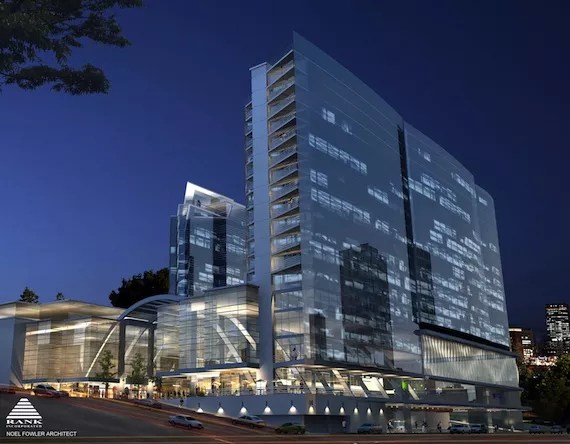
At its regular Tuesday meeting, Halifax council OKed the framework for a contract with the province and Rank, Inc. for a new convention centre. Council did not vote on a specific, detailed contract because “the details are still being worked out,” said deputy CAO Mike Labrecque, who however assured council that those details would reflect only “minor” changes from what was presented to councillors.
Labrecque did not say why he didn’t wait until terms for the final contract were reached before bringing it to council. Even when the contract is finalized, Labrecque made clear that it would not be a public record.
In any event, the convention centre project should start seeing the light of day soon, and should open in 2016. Here’s what happens now:
Construction
Despite assurances that construction will begin “in weeks,” developer Joe Ramia still has to bring the project to the Design Review Committee, a group created by HRM By Design to vet new construction. Already some committee members have expressed concerns about the concrete massing so close to Argyle Street, and details about the Market Street pedestrian mall will also be a matter of contention. Expect the review process to take a few months, before cranes start working the site.
Hotel and office building
Remarkably, Labrecque said there is no requirement in the contract that Ramia actually build the hotel and office tower that are part of the convention centre project, although in the past Ramia has said a major hotel chain has committed to occupying the 18-storey hotel, and the project was delayed as he secured tenants for the 14-storey office building.
The city did secure two $2.5 million “letters of credit” from an unnamed bank that will revert to the city should Ramia not proceed with either building, and so “he’d lose $5 million out-of-pocket,” said Labrecque. Of course, Ramia wouldn’t personally lose the money, as the project is fronted by a limited liability corporation.
It’s expected that Ramia will soon announce who the tenants of the office building are, and at that time we’ll learn if they are new-to-town, or simply existing Halifax operations that are shuffling office space.
What will it cost?
Calculating the true price tag for the convention centre is complex. The governments’ construction costs are a total of $164.2 million; the federal government will pay $51.4 million of that on the day the convention centre opens, but the balance—$112.8 million—will be split by the city and province, and financed by Ramia’s bank over 25 years. The direct costs for financing will be $5.1 million annually, for each the city and the province.
Additionally, the city and province will split operating costs of the convention centre. City finance director Greg Keefe said the city’s share is estimated at $1.45 million annually, but “projections for that cost are not final.”
Then there’s the new management structure of the new convention centre. The existing convention centre is ultimately a provincial responsibility—the province pays for deficits—but the new one will be split 50/50 by the province and city. This means that future city liability is potentially unlimited. If the convention centre loses $2.5 million in a year (like it did in 2008), the city will be responsible for $1.25 million of it; if it loses $5 million, the city will be out $2.5 million.
On the city side, Labrecque admitted that the city would face a potential “cash flow crunch” soon after the new convention centre opens in 2016, and so the contract includes a provision that allows the city to defer, with interest, up to 25 percent of its first 10 annual payments, with the deferral financed by the province. The city would be charged the province’s 10-year borrowing rate, plus one percent, which today would be 4.65 percent total.
That deferral achieves a remarkable degree of non-accountability. Should the new convention centre fail to meet revenue goals, the bill to the city will not come due until 2027. By that time, every city official and every city councillor responsible for the deal will have either moved on, retired or died. The debt will be someone else’s responsibility.
The above financial arrangements were passed by the full council vote of 19-5, with councillors Reg Rankin, Peter Lund, Jackie Barkhouse, Jennifer Watts and Debbie Hum opposing.
The existing WTC
Probably the greatest cost to the city, however, will be the purchase of the existing convention centre and the office tower above it. The contract calls for the province to attempt to sell the complex, but with a weak downtown office market, everyone admits that’s unlikely. If it isn’t sold to someone else, the city is required to buy it in 2016.
Two years ago, the cost for that purchase was pegged at $12 million, but some councillors say it could be as high as $15 million by 2016. A much greater cost, however, would be the renovation of the building, which one councillor said could be $35 million.
Then there’s the question of what the city would do with the building. City offices are now mostly housed in the privately held Duke Tower, but the lease doesn’t expire until 2021. There are also city offices in the city-owned Alderney Landing, but it makes no sense to move offices from one city-owned building to another. In addition to TCL offices, which will presumably mover over to Ramia’s new tower, the WTC building now houses several provincial departments, but with cuts to provincial staff and the re-locating of provincial offices to rural areas, there’s no certainty that the city can maintain those leases.
As for the existing convention centre in the basement of the building, councillor Dawn Sloane hoped that it could be turned into a municipal archive/museum, at unspecified cost. David Hendsbee suggested that the Art Gallery of Nova Scotia would want to move into the space, an idea that will no doubt catch AGNS by surprise.
The potential purchase of the existing WTC complex was approved on a council vote of 21-3, with Barkhouse, Watts and Sue Uteck opposing.
Tax revenue
The new convention centre, hotel and office tower will of course generate property tax revenue and, arguably, increase assessments of nearby buildings, resulting in increased tax payments to the city. Three years ago, a consultant hired by TCL put the increase in revenue for the city at $3.65 million annually (page 4 & 5)—that is, before the city pays the $5.1 million construction financing cost, the $1.45 million operating cost and half the new convention centre’s deficits every year, as well as the cost of buying, refurbishing and operating the existing WTC complex.
Tuesday, however, council was told that the increased property tax revenue will more than cover the city’s costs, albeit maybe not for those first 10 years. No actual figures were put forward to back up this claim, but there has been another change since the 2009 consultant’s report—now, the city is required to pay half the convention centre tax bill, to itself. The consultant had predicted that considering only the new convention centre tax payments, the city would receive an increase of $600,000 a year, but since the city is now paying half the bill, that figure will be just $300,000.
Reached Wednesday, Keefe said the independent consultant’s 2009 estimation has been superseded, and referenced a single PowerPoint slide put together by city staff for a presentation to council on November 9, 2010 (slide 44). That slide, which doesn’t explain how the numbers were calculated, shows an expected net increase in property taxes to the city of $3.783 million. “Over time, the value of the property, and therefore the tax, will increase to equal and exceed the costs, which are mostly fixed,” assures Keefe.
This article appears in Jul 5-11, 2012.

Snake oil on special sale – a one time offer ……(for the moment)
We are either governed by corrupt tools or oblivious morons, I cannot fathom which. They are remarkably inefficient for tools and lack the fifty per cent random chance of getting things right of the foolish.
Thanks very much Tim.
This is a great summary and will form a part of the public record along with future revelations about who will run this thing if it becomes operational and of course how all that works out.
$6m a year is no trivial sum, but of course it won’t make or break us in the long run. However, the people and processes that got us here, along with the unknown costs of managing, maintaining and marketing could.
In the past, when things like this have happened in Nova Scotia (and they’ve happened with sickening regularity) our natural wealth, business and generally improving economic growth have saved us. Let’s hope history repeats.
You are saying that the city alone will pay $5.1 million in annual construction financing cost. Where did you get that number from?
In December 2010, council voted to approve it’s share of construction financing in the amount of $56 million, to be paid over the duration of a 25 year lease. This translates to around $2.25 million each year, not $5.1. Perhaps you mean that the $5.1 million is the total annual cost to be split 50/50 between the city and the province? If so, please clarify/correct that in the article before people start thinking that the city is paying over a $100 million in construction financing over the period of the lease.
Issmat– I got it out of the mouth of Greg Keefe, and in an email directly from him.
My email question to him:
First, just to confirm, I understood that the city’s annual payment for financing construction will be $5.5 million for 25 years. Is this correct?
His response:
First, the annual lease payment is $5.1 million, one half of the $10.2 million tendered.
Hell, I’m happy to show you the whole conversation…
BOUSQUET:
Mr. Keefe,
good morning. I have a couple of questions about the convention centre financing arrangement, that I’m hoping you can answer.
First, just to confirm, I understood that the city’s annual payment for financing construction will be $5.5 million for 25 years. Is this correct? What is the interest rate for this? Whatever it is, I understand this to be significantly higher than what the province could secure, but going the provincial route would mean having to call the project a capital cost and adding to both the provincial and city debt; by going through Ramia’s bank, the governments can call the annual payment a “lease” and therefore an operating cost, as opposed to a debt payment— they pay a higher interest rate but avoid the political repercussions of adding to debt. Is that an unfair characterization? If so, how so?
Second, if I heard you correctly (please forgive me if I didn’t— things were very rushed, and you spoke quickly), you said that the city and province would be splitting operating costs of the new convention centre, which I *think* you said was $1.1 million “more than we’re paying now.” I understand that to mean $1.1 million more than the city’s existing subsidy to Trade Centre Limited, which last year was $571,899– so is the city committing to $1.7 million? What’s the exact figure?
Third, what are the specific terms of the potential 25% deferral of annual payments? Does that include both the financing and the operating payments, or just the financing? At what interest rate? Compounded annually, semi-annually, or what? Is payment due in full Day One of Year 11, or when? I’m guessing the province will assume the deferred payment… do you know how they will account for it?
Fourth—and this is the most confusing issue for me, because honestly I don’t understand how this works at all– Trade Centre Limited lists a $40.7 million deficit: http://www.novascotia.ca/finance/site-fina… , which includes I realize everything rolled together– future financing costs, the assets and liabilities of the existing WTC, etc. Can you unpack that for me? How does that $40.7 million just disappear, especially seeing how the city is assuming the existing WTC (or rather, almost certainly will assume it)? Will that deficit be rolled into whatever new organization operates the new convention centre, or is it just wiped off the books somehow?
Thanks very much for your assistance, and especially for your time.
Best,
Tim Bousquet
KEEFE’S RESPONSE:
Good Morning Tim,
First, the annual lease payment is $5.1 million, one half of the $10.2 million tendered. This would have been based on the developer’s cost of money at the time. This will be finalized in the next few months based on the developer’s cost of money today, which I believe will be lower. I don’t think your characterization is fair. From HRM’s perspective, the contract is between the Province and the developer, HRM cost shares with the Province, so under either scenario, this would be an operational expense to us. Even if we were to structure it as debt, HRM’s debt is not high relative to other government entities, so there is no non-financial reason to avoid it. You should ask the Province for their thinking, as I can’t speak for them, but as this would be treated under accounting rules as a capital lease, it would hit the books as an asset, the same as if they had built it.
Second, the operating costs of the building is $1.450 million, one half of the tendered $2.9 million. As the analyst who worked on this file is on vacation and I wasn’t completely sure where he allocated our current costs, I was being conservative in how much I netted this figure. This $2.9 was based on the landlord providing for the operation of the building at a fixed price for 25 years. We are now looking at the operator of the convention centre doing this, and pay as we go. The projections for that cost are not final, but we believe they will be lower.
Third. This includes everything. The interest in compounded annually, and the rate would be the provinces 10 year borrowing rate at the time, plus 1%. This would work out to about 4.65% today. This is similar to the rates we pay when we borrow through the Municipal Finance Corporation. I don’t know how the Province would book this, another question for them, but I suspect it will just be a receivable. The amount would be due in year 11 from the time we started deferring. It could be earlier if our cash flow returns to a positive position in those 10 years.
Four. I can’t help you with this one. HRM’s options and obligations relate to the building, not Trade Centre Limited. TCL is a Provincial crown corporation, so any questions about their deficit would need to be directed to them.
Hope this helps
Greg
XXX
We went on to have more of an exchange, but I think it’s clear from this exchange that Keefe repeatedly refers to the city payment as “half the… amount tendered,” that is the total city & provincial payment.
“Even when the contract is finalized, Labrecque made clear that it would not be a public record.”
This is familiar to us on Prince Edward Island. Our current government sold a provincially- owned-and-operated senior citizens residence, together with the prime city land on which it sat, to a private developer and the entire deal remains secret. A Freedom of Information application failed. We voters need sunshine laws and FOI laws with sharper teeth.
Thanks Tim. I’m not sure if you’re reading his email the same way I am, but I believe when he says “Third, this includes everything.” Perhaps he means that the $5.1m estimate includes the annual operating and maintenance cost.
Maybe this requires a follow up question to Keefe for clarity. I believe there’s a misunderstanding in the interpretation of Keefe’s response. Notice that you asked if the $5.5 million is for “construction financing”, and he responds that the figure is the “lease payment”. The lease payment was originally intended to cover construction, operation, and maintenance.
I also think the response was misinterpreted because yesterday’s motion document reads:
“As per the December 2010 agreement, the Province of Nova Scotia will enter into a long-term lease with the developer for 25 years that covers the construction costs of the convention centre. HRM will enter into a Memorandum of Agreement with the Province to share 50% of those costs. This commits HRM to a substantial annual cost of just over $6 million to pay for the construction, operation and maintenance of the new Convention Centre.”
So, in December 2010, council approved the payment of approx. $6m annually as their 50% share for the developer to build, operate and maintain the building. The only change in yesterday’s motion was that the city/province decided to take on the function of operating and maintaining the building directly instead of paying the developer a flat annual fee, as part of the lease, to do that for them.
This change will reduce the operation and maintenance cost, since the developer’s flat fee probably included a margin for the developer that the city/province will now avoid by managing the building directly. So, we should still be looking at a figure that’s between $5m and $6m for everything, which is what council budgeted for all along since 2010.
An important note: there is confusion among some people about the word “operate”. Some folks in the city and the media have used the term interchangeably to describe the operation of the building/facility and also to describe the operation of the convention centre.
It’s important for people to understand which of these “operations” are part of the $5m to $6m budget and which is not.
‘Operation’ in the context of the building/facilities refers to facilities management and maintenance, like taking care of heat, water, air, gas, garbage… etc. ‘Operation’ in the context of the convention center refers to running the actual convention business of attracting/conducting conference, meetings and trade shows.
This throws some people into confusion when they hear that the developer was going to “operate” the building, and now he’s not. So just to be clear: the developer was never going to operate the “convention center”, just like he doesn’t operate the call center in his other building on Bayers Road, but he does operate his building there.
“The province and the city are contributing $56 million each to be paid in the form of a capital lease over 25 years. “
This is the line thrown about in all the articles on the convention centre. My assumption is that the 56$ mil represents the net present value (NPV) of the lease agreement.
This NPV with 5.1$ mil payments over 25 years would represent an 8.6% interest rate in order to justify the 56$ mil figure. Spanish 10 yr bonds, a very risky investment, do not even yield over 7% at present.
It would be very helpful to everyone if someone from HRM could clarify the breakdown of expected operational costs. It seems they may look at partitioning the maintenance/utility costs from the business expenses of the trade centre business. It is mighty confusing trying to decipher what exactly they mean by operational costs. Not to criticize Mr. Keefe who is just a temp fill in as CFO, but why can’t he lay out some of the simple financial info from this MOU? Can anyone? I’m a bit confused at how much of a quest the search for important, and uncomplicated, information has become. Glad there are people like you who are willing to put in the effort to find it.
For the record, Jane Fraser, the deputy minister at TIR, confirmed this morning that the city and province will EACH be paying $5.1 million annually, although she thinks the interest rate may come down a bit since that figure was arrived at, so the payment might come down a bit, too.
But Tim that would be over $250m just for construction and the price is only $150m for everything.
Funny how that works, eh?
So is the 56 mil$ for construction cost legit or just a convenient number to throw to the public?
If 56 mil$ is the equivalent present cost then a 5.1 million annual payment for 25 yrs equals to an 8.76% interest rate.
The city’s financial report the city cites the long term borrowing costs at around 4% in 2011. Not sure what long term refers to. But a retail mortgage buyer can get a 25 yr fixed mortgage ’round here at 8%. Loans to municipalities are much much cheaper than that. 30 year Canadian bonds are <4%.
But anyways, here are the net presents for various equivalent interest rates and yearly lease rates, for perspective.
for 25 years we get…..
yearly lease (m) / equivalent borrow rate (%) / equivalent present value (m)
5.1 / 4.5 / 79
5.1 / 5.5 / 72
5.1 / 6.5 / 66
5.1 / 7.5 / 61
5.1 / 8.6 / 56
4.7 / 7.5 / 56
4.3 / 6.5 / 56
4.0 / 5.5 / 56
3.6 / 4.5 / 56
I suggest the NS pension plans for teachers and pen pushers along with the HRM pension plan finance the whole project by lending him the money for 30 years at 5% plus an agreed equity interest.
30 year Canada bonds are at 2.25% which means the pension plans earn a 2.75% risk premium
Other public sector pension plans are investing in real estate around the world.
$150m for everything? I think the only people throwing that little nugget of misinformation around are right here at the Coast, just so they can turn around and argue, against their own invented number, that it’s an inaccurate representation of the total cost.
The deal has always been, since council’s vote in 2010, that the city will pay $56m towards capital construction cost, split across a 25 year lease. In addition to that $56m, the city and the province agreed, in 2010, to split the annual cost of operating and maintaining the building 50/50, and were going to have the developer provide that service – also over 25 years of lease payments.
And just so nobody gets hit over the head tomorrow with the following “news”: the city also agreed, in 2010, and in addition to all the above, to cover any annual deficits that the convention operator (TCL or whichever other public operator) might have for the duration of the agreement.
All the above information is known and was announced in December 13, 2010, and reported on by… The Coast! The link to the news release is https://conventioncentreinfo.com/province-…. This information was preceded by an overwhelming majority vote by council (22-2) in favour of approving the convention center.
That information was also clearly reconsidered and re-ratified this week, with another overwhelming majority of councilors (19-5), who are all very well aware of all the cost implications, voting in favour. Council voted in favour because, in the opinion of the vast majority, the benefits of the project were determined to far outweigh its costs.
I hope the above clarification puts this campaign of misinformation and pretend-shock about all the ‘unconsidered costs’ to bed.
All these costs are not just creeping out now. These costs were part of the initial consideration of the project that council discussed, considered, and voted on. The Coast reported extensively on them since 2010, so claiming ignorance now is hard to believe.
Attention should now be turned to the 11 public consultations that will take place to discuss building design and such issues – a much more productive discussion than trying to go back and reiterate the same objections from two years ago that have already been settled.
issmat:
i’m no mathematician but i’ve got some simple questions that no one has been able to answer to my satisfaction:
1) if this is such a great business venture, likely to make whoever gets behind it a lot of money, why does it need one thin dime of taxpayer money, from the feds, province or city? couldn’t rank just borrow the money themselves and finance the whole thing and keep all the profits (and losses) private?
1.5) if it isn’t such a great deal, why involve the private sector at all since a) the city can borrow money more cheaply and b) the city is on the hook for any losses anyway? (and why don’t we share in the profits as well as the losses?)
2) if we can’t sell time in our convention centre now, shouldn’t we find out why before we build a bigger, more expensive one that just might sit idle as much as the current one?
2.5) how many of the incompetents working at TCL who have been managing the thing into the ditch for the past several years will simply move into nicer offices down the street when the new place is built – and likely at higher salaries due to the fact that you know, it’s a larger convention centre and for which it will likely take more work to attract conventions? if we’re going to do this, shouldn’t we be jettisoning those who have already proven they can’t work with what they have already? a lot hinges on their job performance. with this much taxpayer money being risked, shouldn’t we at least make them re-apply for their jobs to prove they are the best candidates for such important work?
3) how many jobs will this really create? not unionized construction jobs that are temporary. let’s get real: how many low-wage service sector jobs with few-to-no benefits will all this taxpayer money buy? is this -as a strong selling point for all projects like this one- really a good value for the money? if it isn’t, why are we doing it this way?
3.5) insofar as the figures released tell us, who will really profit the most from this whole thing: will it be the bank(s)? rank, inc? the buyers of convention space, as we lowball our rates to stay competitive? the only ones saying it will look good for the taxpayers are those with a lot more to gain, wouldn’t you agree? if not, again, why do they need for the taxpayers to assume all the risk?
4) what are the contingency plans for a worst-case scenario? what if the cost of fuel goes through the roof (or a terrorist attack occurs, or a new conference call technology is developed, etc etc …) and business travel in general starts to decline rapidly? what will happen if all of the cheerleaders for this thing are dead wrong? who will lose their jobs? where will all the money come from? who will then recommend which city services will be cut, and whose property taxes will need to go up? will it be the same city officials who championed this thing from start to finish?
5) do you think joe ramia will vocally and loudly support dexter and the provincial NDP gov’t in the next campaign now that they’ve given him exactly what he wanted (cash with no strings)? or will he be another one of these wealthy plutocrats who are constantly demonizing the NDP by characterizing them as irresponsible tax-and-spenders? will he refuse to add his voice to those in the private sector demanding that if we want to see economic growth in nova scotia that ‘government needs to get the hell out of the way of business’? or do you think he’ll just applaud the feds’ help and downplay the role of other gov’ts?
5.5) if he doesn’t admit that a progressive social policy (not a conservative one) is doing more-than-right by him and his business interests, what do you think that says about him as businessman? if he’s willing to let the taxpayers assume all the risk, does it make him shrewd? or a full-blown socialist?
these are simple questions every taxpaying layman would like answered. typical nova scotia: zero accountability, before and after the fact. some people think this city sucks because we have no nice buildings like the one proposed. the connection these people fail to make that it’s precisely because we keep making deals like this one (with privatized profits, socialized losses) to advance projects like this one that is the reason this town sucks so hard. you get no love for your business from the gov’t -any of them- unless you’re talking in the tens of millions. then, they line up to shine your shoes. why?
It is almost the definition of rationality to say that a person is rational to the extent that he will tell you under what circumstances he will change his mind. To know when a belief will be considered false is to know how to reason with someone who holds that belief. It is a mark of psychosis that someone will not under any circumstances change his mind.
Can you specify the following?
How much is too much money?
How much annual loss is too much?
How much risk is too much?
How much public distaste for a project is too much if it is financed with public money?
How is it determined this is the best possible investment for Halifax? For Nova Scotia?
Would you change your mind if:
If the core proponents turned out to be self-interested would that change things?
If it turned out that the analysis was based on faulty assumptions would that change things?
If it turned out the economic downturn was severe in the rest of the world? In Nova Scotia?
If it turned out the industry model was changing?
If the decision making process was suspect?
If it turned out the decision makers didn’t have good information?
If it turned out influence was pedaled?
If it turned out that building convention centres did not create new wealth of economic prosperity?
If someone had an idea most folks (but not you) agreed was better?
From my point of view, I believe that creating the symbols of success will not actually bring success. That’s an ideological position – mistaking the symbol for the thing symbolized is a classic and ancient human foible. So I asked that a process be put in place to decide together what the best possible investments were (when compared side by side) for Halifax, and for Nova Scotia. And I wanted to do the same for the blank slate piece of property at the centre of the downtown.
Can you say why we did not do that?
If you knew that process was not followed would you support the random or corrupt result instead?
Do you believe that critics should not speak out as citizens and media authors?
It is not the duty of the critic to become responsible for correcting the deficiency he has found. This argument is frequently used to prevent the critic from pointing out what is wrong.
Unpleasant facts are unwelcome and no one builds statues to critics.
But we must face the stark fact that an uncriticized society cannot long endure.
Do you believe the citizen should not criticize unless they have the power to force an alternative?
Downtownleroybrown:
I won’t delve into each specific question, as they mainly regurgitate all the criticisms and concerns that have already been dealt with extensively through consultant reports, council discussions, and media articles since 2010. All your questions about the project can be summarized to this:
A. “What is the business case or economic benefit of the convention center”?
B. “Just kidding! That was a rhetorical question. I have already determined that due to the proliferation of new communication technologies, the increasing cost of travel, and stronger competition from larger convention centers in other cities, face-to-face conferences and trade shows will become obsolete. Thus, this new convention center will also become obsolete, sooner or later, and we’ll be stuck with the bill.”
These two questions have been extensively discussed. There was (and will always be) a difference in opinion between opponents and proponents about the direct and indirect economic benefits of the project. Thankfully, we don’t have to keep going in circles around each other forever, because at some point a decision had to be made. So, the matter was eventually voted on and settled.
Now here is the important part: we are governed by a democracy. In a democracy, decisions are not made by consensus of the whole. They are made by consensus of the majority. I believe it was Churchill that noted democracy as the worst form of governance, except for all the others. In this case, the consensus of the majority was that this project is a good idea.
Another important distinction is that tax payers (through elected representatives) asked for this new convention centre, not the developer. You personally may not have asked your representative to support this project, but other tax payers did, and the overwhelming majority vote in favour of the project at council is an indication that tax payers, other than yourself, do support it and are satisfied with the anticipated potential economic spinoffs vs. the potential risks.
Proponents of the project believe that the new convention centre will provide an important public benefit to the local economy. Opponents obviously disagree.
If you recall how all this started, our elected representatives in the city and province determined that we should have a new convention center. They issued a tender competition for it and several developers responded with various proposals. The winning proposal was Joe Ramia’s. It could have just as easily been someone else if they had offered a better deal and/or location. The initiative has always been led by the government, not the developer.
As for the developer’s potential political leanings at some unforeseen point in the future, I don’t think anyone can speculate. The project construction is only one-third financed by the current NDP government. But remember that one-third of it is also funded by the federal Conservatives, and the last third is funded by the non-partisan city council.
In the end, this is business, and regardless of the government of the day, business people try to work cordially with it and lobby for what they believe is in the best interest of their enterprise and the collective business environment they operate in.
Tell you what John – how about you tell me under which circumstances are YOU willing to change your mind, and then I’ll be happy to share the same. After all, I assume your definition of rationality, and psychosis, works both ways, no?
Criticizing, opposing, and questioning things is fine. Spreading misinformation is not. My comments are meant to repute and clarify a lot of the misinformation, misrepresentation and misinterpretation that surround reporting and comments about this project. My aim is not to stop you from criticizing. Like you, I’m just an engaged citizen advocating for my vision of Halifax.
The process you’re suggesting for making decisions in the city is a fantasy. It’s a nice fantasy about a utopian form of governance where different stakeholders come together and put aside their conflicting visions, consider competing projects side by side (assuming they’re proposed simultaneously), then arrive at decisions by having everyone agree on what is “right”.
In the real world, society doesn’t make decisions that way. There will always be people for something and others against it. Everyone has different priorities and visions and definitions of what is “right” based on their own political, religious, cultural or historical ideologies and influences.
In the end, our system of democracy ensures that there is a way to move forward. We all agree to abide by a certain social contract or else we’ll be ruled by anarchy and chaos. That social contract is to accept the will of the majority, and to discern the will of the majority by voting.
We can go in circles forever. For every rhetorical question you pose, I can ask you the same: How much public money is enough? How much risk is just right? Our answers to these questions will predictably lead us down the path of our previously established positions: you will conclude that the project is a bad idea, and I will conclude that it is a good idea.
So let’s leave the rhetoric aside. The public has spoken and the aye’s have it. Feel free to criticize and disagree. That’s your right as a citizen and a tax payer. But please don’t lead a campaign of slander and vilification against people who support the project.
I did ! In the note. I said that if we had proper and transparent processes that strategically compared alternatives for the investment and for the property I would have gone with the best of both. It’s that simple.
None of my questions are rhetorical. They are all practical and useful.
If you only answer one, just answer the money question.
Most people have said zero public money.
I would say a tax credit up to the amount of taxes otherwise payable, given only if the developer did what he said he was going to do. By most calculations that would have been a couple million per year and would have provide auditability and risk management.
Regarding my ideas about how the process should have worked: Being able to rationally order individual preferences into a rational social order to determine the best alternative is not a ‘fantasy’. It is the logic underpinning our entire system of government.
The money question “how much is too much?” doesn’t beg an actual number for an answer. It’s rhetorical. And therefore the answer is also going to be rhetoric: rhetoric that justifies the position of the person answering the question, one way or the other.
So here’s my answer: “as much as we can afford to, based on where this project falls in the city’s list of priorities, as defined by the electorate.”
Priorities are viewed differently by different people, so we’re back to square one of a circular argument.
Even if it was somehow feasible to have different projects proposed simultaneously and compete for mutually exclusive funds, the outcome will be the same: there will be a difference in opinion between various groups about what the ‘priority’ is, and the deadlock will be broken with a vote. Exactly like what just happened at council – twice.
You don’t think that part of the consideration at council was ‘what else could we do with this money”?? Ofcourse it was . And the long lineup of citizen interveners who spoke during council sessions made sure to raise that question over and over again.
Ultimately, it was considered, and the decision was that this was a priority to the majority.
Why can’t you accept that a transparent, democratic process did take place? Just because you don’t like the outcome of the process doesn’t justify your claim that the process was faulty or corrupt, or that the folks who participated in it are miscreants or dishonest.
Unless you have some evidence of fraud, vote tampering or something like that, you should accept that the process worked – not in your favour, but it worked.
Funny stuff.
Though it seems Inconceivable, I get more sure that you don’t know what the word rhetoric means. You use it the way Tea Party activists say Liberal or The Democrat Party.
Nothing is less rhetorical than math: How much is in the bank account? How much can we afford? How much did that cost?
These questions are about as practical as you can get.
“How much is too much?” and “How much does it cost?” are two different questions. The first is rhetorical, the second has already been answered.
Definition of “Rhetorical Question”:
http://en.m.wikipedia.org/wiki/Rhetorical_…
Not all questions in rhetoric are rhetorical.
I’m hoping to sell you some ^%**@.
I know there is a price beyond which a reasonable person will not want to buy.
How much is too much?
Is there a price beyond which you would change your mind and not support the CC deal?
I just can’t be any more literal than that with my rhetoric.
“Is there a price beyond which you would change your mind and not support the CC deal?”
Yes. That price is not a specific number. It would be the price point beyond which the city can’t afford to do it, given how much money it is willing to allocate to having a new CC compared to other expenditure priorities – those priorities being set (or at least informed) by the electorate.
Fortunately, we’re not discussing some hypothetical situation here about an unknown number that’s yet to be debated. We’re discussing something with a price that is known, and its affordability has already been debated and determined.
The current price may be too much for some, but it’s fine for many – as displayed by council’s majority vote.
Why do you insist on suggesting scenarios that contemplate an alternate reality (where the price is $500m or $1 billion), and then argue against those made-up scenarios? All that matters is the actual scenario – the actual price. And that price has been determined, by the majority, to not be “too much”.
Dude, I’ve never argued on price. Because I’m an accountant I noted some price factors – but that is not my problem. I’ve argued on ideology, opportunity and process. I am asking about price because it seems that the proponents… well, you’ve pretty much said exactly what the proponents say.
issmat,
I went through your comments to find out where you clearly state the known pricetag. Your response to Tim’s e-mail clearly shows that you still have questions and uncertainty. The numbers passed out by Keefe and Fraser are probably the most reliable, up to date and clear numbers passed out publicly. If they are unclear then there is no clear public statement.
Also noted from Tim’s emails is that the province and city have 10yr borrowing costs around 4.65% today. Quite different from the 8.76% deduced from a 5.1$ mil/yr payment over 25 years with a current value of 56$ mil.
issmat: if you guys are so confident the public is behind it, put it to a plebiscite. like all deals like this should be. but you don’t dare, do you? we’re all sold the upside. where is the contingency plan for the worst-case scenario? i have done digging of my own and spoken with folks more knowledgable about this process, including my councillor. if it’s public, no one knows what it says or is willing to reveal what it says. we know what it says though. the fine print says we get the bills. all of them. what they might total, no one can say for sure. so what responsible government walks into a deal with unlimited liability? and you still think this is a good idea? wow. btw, thanks for the quick brush-off of the things that might slow down “progress”. that’s “democracy” right?
you see democratic principles at work. i see in-camera meeting after in-camera meeting. i see a corrupt mayor at the helm of this ship of state. and i see a provincial social democratic party desperately trying to win over a business community that’s happy to take handouts (i.e. our money), but will never support them at the ballot box in a million years because they “will drive the economy into the ground”. it’s duplicitous.
something you just call “business”, i suppose.
marcl:
No, the $56M is NOT a legitimate representation of the actual construction cost.
The $56M is purely the city’s share (split 3-ways with the Feds and the Province) of a 25-year lease (and apparently the associated leasehold improvements) on the Convention Centre component of the new development.
Beyond that, the city and province will be sharing the costs of actually operating the Convention Centre within the space they are leasing. These costs will clearly vary depending on commodity and labour prices, and also depending on the Centre’s ability to recover some of its costs through its bookings.
Actual construction costs must be dealt with in the context of the cost to build the entire development (of which the Convention Centre will be but one tenant). This has been estimated at around $500M. Ramia’s company will finance these costs as a private operation. I would expect that number to fluctuate somewhat, but I would not expect the city’s $56M share of the lease to move significantly.
I am curious, though, what the exact source was for the estimate of $600K in property taxes due to the “Convention Centre”. Is that the tax bill for the entire Nova Centre development as a whole, or is it only against the portion of the development that would be dedicated to Convention Centre operations? I ask because the current commercial property tax rate in the downtown urban core is a little more than $3 per $100 in assessed value, suggesting that a tax bill of $600K would correspond to an estimated property assessment of a little less than $20M. Is that a reasonable estimate for the property value of the overall development? (For reference, HRM’s mapping services webpage tells me that the lot housing the neighboring Prince George Hotel and associated businesses is assessed at just a little less than $20M.)
I can just see it now, hords of snivil servants crowding into a brand new building, lead by non other than Joan Jessome no doubt looking for the wash rooms so that she can unload a ton of sh*it ever notice that her complexion was a brownish tint? No sense spending moola on the Raulston building on Hollis is there when it is so easy to just waste it on Argyle, plus the watering holes are closer time for two more, and then back to works fuc*ing up the businesses of Nada Scotia, right Peter ?