


Every year in March, the Canadian engineering community celebrates National Engineering Month. In-person and virtual events are held across the provinces and territories with the intent to showcase the diversity, ingenuity and resourcefulness of engineers as they work to find innovative solutions to everyday problems. In this province, engineers are licensed by Engineers Nova Scotia, and you might be surprised at how much you rely on them in your everyday life!
For a list of National Engineering Month activities, see our website.

Everywhere you look, you will see an engineer’s work. Every road Nova Scotians travel, every building they enter, every service they receive, every convenience they enjoy and every meal they consume has been made possible through something designed or built leveraging the knowledge, expertise, skill and energy of a licensed engineer. Whether it is health care, the food industry, supply chains, agriculture and fisheries, transportation, telecommunications, digital services, natural resources and energy, environmental protection and safety or the many other services that drive Nova Scotia’s growth, our over 8,000 licensed engineers and engineers-in-training contribute significantly to our province’s success and enhancing our quality of life. And it’s Engineers Nova Scotia’s job to make sure they are at their best.
Our purpose is to license registrants who are qualified and competent, assisting them to fulfill their obligations to practice engineering in the best interests of the public. What we are striving for is a safe and sustainable Nova Scotia protected by accessible, progressive and trusted regulation of the engineering profession.
For details about requirements to practice engineering in the province of Nova Scotia, visit our website.
What is self-regulation?
Since 1920, Engineers Nova Scotia has been an active and effective self-regulating body fulfilling its duties under the Engineering Profession Act. Self-regulation is a privilege granted by the government of Nova Scotia to professions in the public interest. It is one way the government may choose to protect the public and reduce risks associated with incompetent and unethical practice. Self-regulation comprises two key elements: The authority to register and licence members; and the authority to investigate and discipline them. By granting self-regulation to a profession, the government grants the profession the powers it needs to develop, implement and enforce rules to protect the public and ensure that members of the profession provide services in a competent and ethical manner.
The powers granted to Engineers Nova Scotia, and its obligations, are described in The Engineering Profession Act.
How can you become a professional engineer?
Given that engineers impact our lives so greatly, it is important that only those applicants who have the required academic background and practical experience are granted a licence. Those who meet the requirements are licensed as professional engineers and may practice independently; those who have the requisite academic background but do not have sufficient practical experience are registered as engineers-in-training, and can contribute to the practice of engineering as long as they are supervised by a licensed engineer. The normal route to licensure is an accredited undergraduate engineering degree and four years of acceptable and supervised engineering practice. For those who have completed undergraduate or master’s degrees from universities not accredited by Engineers Canada, successful completion of supplementary exams may be required to demonstrate a sufficient academic foundation.

Who can legally provide engineering services in Nova Scotia?
Engineers Nova Scotia maintains a register of licensed engineers, engineers-in-training and companies. You can search for registered individuals or companies by name on the Engineers Nova Scotia site, here.
Why do engineers need a licence?
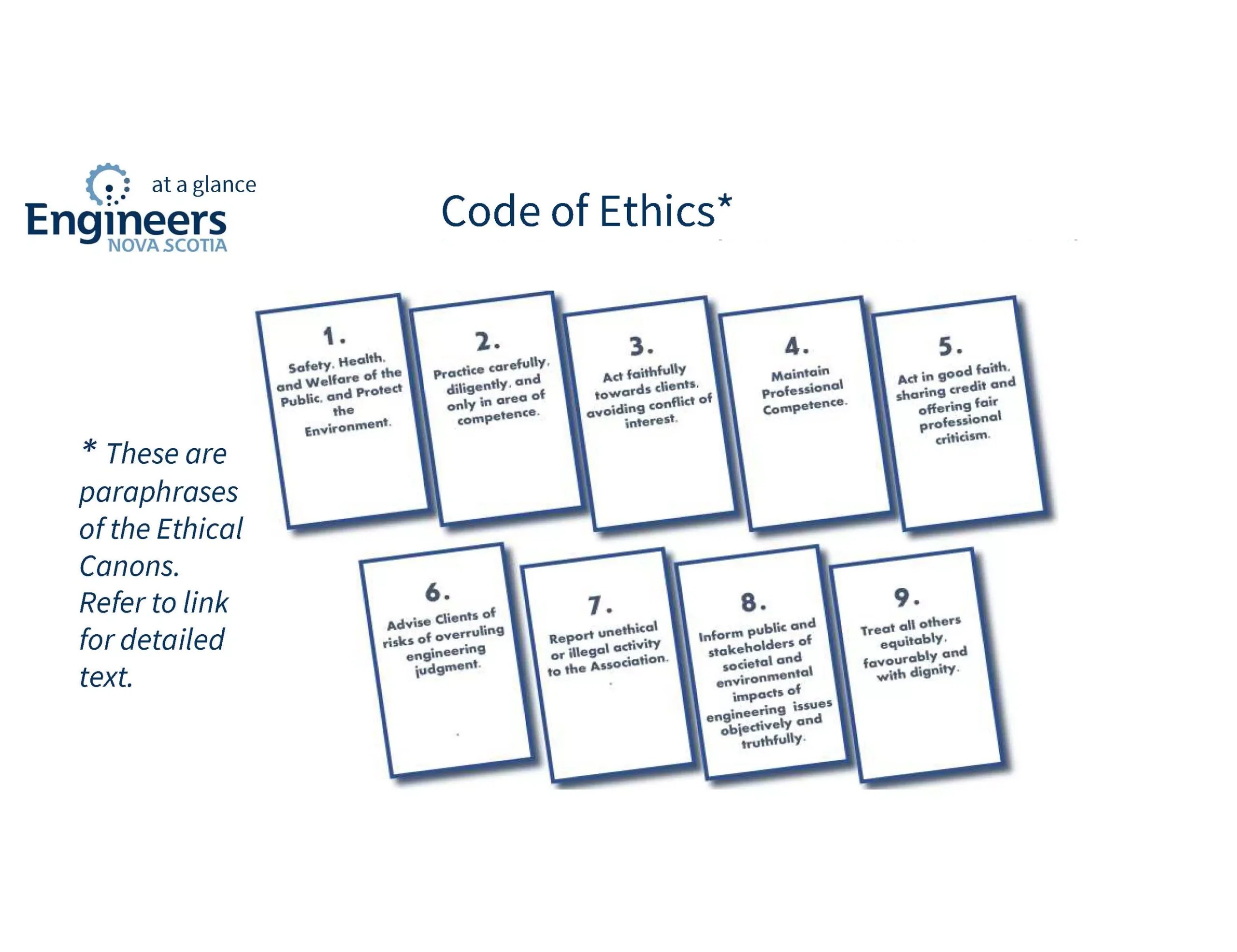
Professional licences exist to ensure that only competent people are offering certain professional services. Like all professionals, including doctors, nurses, teachers, accountants, lawyers and others, engineers must continually demonstrate competence and conduct their work in compliance with a code of ethics.
What if an engineer practices poorly?
Any person who has a concern about the work of a licensed engineer in the province of Nova Scotia may raise this concern with Engineers Nova Scotia. Using the code of ethics as the framework to investigate unethical conduct or unskilled practice, our self-regulatory committees will conduct peer reviews of the allegations and, if found, a member of Engineers Nova Scotia can face a disciplinary hearing. If the engineer is found guilty of unethical conduct or unskilled practice, the discipline committee can impose a range of sanctions, up to and including loss of licence.
For information about the Engineers Nova Scotia complaints and discipline process, see our website.
Working for a safe and prosperous Nova Scotia
As Nova Scotia’s population is now over one million and continues to grow, so will the need for infrastructure and services and products. Licensed engineers are key players in developing Nova Scotia while safeguarding the welfare of the public, protecting the environment, responding to natural disasters and weather events, and contributing to health and safety within the workplace.
Engineers Nova Scotia is proud of the work licensed engineers conduct, as they help to build a safe and sustainable Nova Scotia.
This content has been developed and paid for by Engineers Nova Scotia without involvement from The Coast’s editorial department.
This article appears in Feb 1-28, 2023.
