

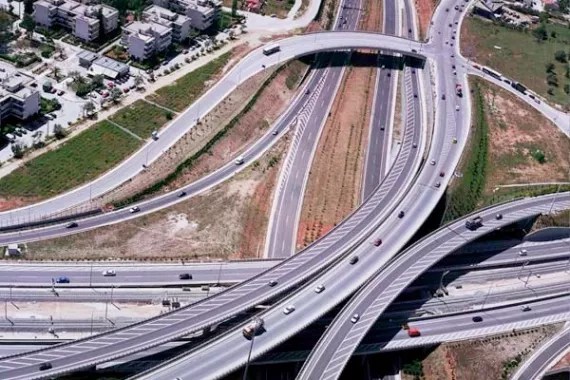
As the city wrangles with the question of whether it should subsidize the cost of operating the Common skating oval at an annual estimated cost of between $110,000 and $250,000, Halifax council is poised to blithely, unthinkingly, OK the expenditure of $2.8 million to subsidize suburban sprawl in Bedford, and an as-yet untold millions more to improve car access into the suburban Bayers Lake shopping district.
Tuesday, council will deal with two budget issues related to suburban sprawl. The first involves the new Larry Uteck Boulevard interchange on the Bicentennial Highway, which is designed to handle traffic generated by new subdivisions being built in Bedford West (roughly, the land between the BiHi, Hammond Plains Road and Kearney Lake Road) and Bedford South (roughly, the land between Oceanview Drive, the Bedford Highway, Larry Uteck Boulevard and the BiHi). Council is being asked to tweak the financing formula for the interchange, with total costs pegged at $10,332,771.
Only in 2002 did the city begin to ask for authority to offset some new roadway costs by charging subdivision developers some of the costs associated with the new roads; those charges—known as “capital cost contributions”—began to be collected in 2006.
Arguably, because we wouldn’t need the new Larry Uteck interchange if Bedford West and Bedford South weren’t being developed, the city should simply charge the developers for the entire cost of the interchange and leave it at that. But, explains Peter Duncan, the city’s manager for infrastructure planning, the city is prohibited by the city charter from charging the full costs of the new interchange to the developers; instead, the city has had to complete a traffic study and determine how many cars using the interchange will come from the new subdivisions and how many will come from existing neighbourhoods elsewhere in HRM, and then charge the developers only for the percentage their subdivisions will generate.
This is silly: the existing traffic from elsewhere in HRM is already using existing roads that have been bought and paid for; they might use the new interchange, but it will be by no means necessary to do so, as they’re getting around just fine now without it.
There’s another wrinkle thrown in as well: the costs for extending water, sewer and natural gas lines into the new subdivisions are charged to Halifax Water and Heritage Gas (more on this in a moment). In total, the budget for the new interchange looks like this:

The bottom line is that the city will pay $2,795.250 straight out of the general tax fund to pay for the new intersection that is required only for the new neighbourhoods—that is, it is a direct $2.8 million subsidy to facilitate suburban development.
Halifax Water’s costs
A letter from 2009 included in the council paperwork for this week says that the then-anticipated $900,000 costs to Halifax Water for the interchange will come from another, second, CCC arrangement with the developers. But it’s unclear whether the increased costs—$700,000 additionally, bringing total costs to about $1.6 million—will simply be tacked on to that CCC or will come from ratepayers generally. As of this writing, Halifax Water managers haven’t responded to my requests for more information on how they intend to recover their portion of the Larry Uteck costs. But it is precisely these sorts of suburban costs that led many to oppose Halifax Water’s recent application for a rate increase—the argument was that Halifax Water was paying for new suburban construction by saddling existing water customers in the urban core with higher rates.
Washmill underpass
A second highway project is also coming before council this week—discussion of unexpected cost overruns for the Washmill Lake Court underpass beneath the BiHi, connecting Clayton Park to the Bayers Lake Industrial Park.
The city budgeted $10 million for the project through the economic stimulus program of 2009. The money was split evenly three ways between the city, provincial and federal governments, and the work was to be completed by March 31, 2011.
Fortunately for the city, because so many economic stimulus projects are running behind schedule, the federal government has rolled back the required completion date to October 31, 2011. Washmill Court is one of those projects; says a cryptic note in the paperwork: “Original $10M budget has been spent. Project can be completed in 2011 pending budget availability and Council approval.”
Presumably, the entire cost overrun on this project will come out of the city’s general budget—that is, once again we will be subsidizing suburban development.
How much? We don’t know—the report to council on the Washmill Court cost overrun consists of a staff presentation to be given to councillors in secret at tomorrow’s meeting. There is no justification given for the secrecy, and city staffers aren’t returning my phone calls related to the issue.
There’s no conceivable justification for the secrecy around Washmill Court. But since the continued subsidy of suburban development is pretty much a non-issue, we may as well not say anything about this example of it either, I guess.
But boy howdy, let’s watch the sparks fly when someone suggests spending some chump change on the skating oval, which might help the downtown.
This article appears in Jan 13-19, 2011.

I didn’t say boy howdy when I read the council agenda this morning and saw all of those figures attached to it. I said something a little more… well anyway, thank you for bringing this to your readership. Its weird how this kind of thing doesn’t see the light of day in the mainstream press.
Bayers Lake and HRM Councils desire to flush money into it is reason enough to move far away from here. Why is downtown crumbling again? Oh right, we need a convention centre.
The urban core should be the focus of future growth as you state. However, as soon as a proposal comes along that would help to move in that direction then all the opposition comes out in force. It seems as though there is more opposition against development in the urban core so the simplest path for developers to take is to build in the suburbs even though it is bad for the city in the long-run.
Very important piece, Tim.
Halifax is not alone with this legacy. A few lucky or smart cities (Vancouver, Portland) avoided many of the problems that come with sprawl. Many in the US succumbed to it totally, and today are urban wastelands. The point is that Halifax will need to live through the consequences of its decades of sprawl. Like stopping a ship, you can’t turn on a dime, but if we make changes NOW and stop subsidizing unsustainable development, we will look a whole lot better in 10-20 years. We currently have three times the residential suburban development stock that we need to fulfill demand for the next 20 years. Why would we ever need to approve more, at taxpayer expense?
We need to make some tough, and unpopular choices, with the review of the Regional Plan, which is happening THIS year. That’s the way to make some changes that will (economically, socially, healthwise, and environmentally) benefit all of us.
This is what happens when municipal growth – *boundary* growth – is not well-managed. In this case HRM amalgamation. But it’s nothing new. Back in 1961 when the Town of Dartmouth (very soon afterwards to become a city herself) amalgamated with Tufts Cove/Burnside, Port Wallace, Woodside, Westphal and Woodlawn, the late ’50’s push for this mostly came from the people in those communities, *not* from the ratepayers in town. And it was the ratepayers in the original town who spent much of the ’60’s paying for the build-out of services in those outlying communities, which the county had previously skimped on.
Now we’ve got an analogous situation where ratepayers in the established urban areas are paying to help build out people living practically anywhere in the former county, because now we’re all part of the same happy municipality. For my part I’ve lived all my life – when I’ve been in this vicinity at all – within the boundaries of the former *town* of Dartmouth, and just as I didn’t much like being stiffed to help pay for all those excrescences out past Woodlawn, I’m not too happy to subsidize people over on the other side of Bedford Basin someplace…let alone further out. I can’t help but look at the stretches of Pleasant Street that I drive to get to the Woodside ferry – said stretches are falling apart – or the fact that only now in maybe a year or two are we getting a second Woodside boat, and wonder why the f**k I’m paying for multi-million dollar highway development between Halifax and Bedford.
As has always been the case, now or 50 years ago, development becomes aberrant when there’s too much of a disconnect – too much indirection and too many layers – between who gets and who pays. And bad municipal boundaries contribute. I say roll back HRM amalgamation.
Kudos for bringing this to light. We the ratepayers need this analysis and appreciate the Coast publicizing the comparisons that expose the inanity. The 2.8 mill doesn’t get a mention. Meanwhile, the oval and its civic popularity is pitted against its supposed exhorbitant costs and splashed all over the mainstream media.
As a born and bred suburbanite, I chose to raise my young family in town, on the peninsula. We don’t need two cars, we don’t spend time commuting, we can walk to neighbourhood stores, and we contribute in our own small way to the cityscape itself. Sure, our house is a lot smaller than what we could get in Upper Beaverbank for the same money – trade off for city living.
I was shocked to learn that our taxes at least twice that of an Eastern Passage dwelling. I get that housing prices are linked to market value, but shouldn’t municipal tax rates reflect the amount of infrastructure required to service more remote residences?
I am all for development. But I’d rather see our city get inventive, and create delicious urban spaces for everyone to enjoy. Maybe Sackvillans can jump on the bus and come skating on our oval.
The worst thing is that we ratepayers have no recourse… and this is why we need the Coast.
Now that downtown is getting big ticket items like the new library and convention center and maybe the oval, it’s time to direct future funds elsewhere. Like it or not, downtown has gotten its fair share of tax cash for at least the next 15 years.
Halifaxisn’ttoronto: do you, um, even live anywhere in HRM? When I see a comment like “now that downtown is getting big ticket items like the new library and convention center and maybe the oval, it’s time to direct future funds elsewhere” it leaves me scratching my head.
Peninsular Halifax – not downtown – maybe perhaps gets to keep that skating oval. In the meantime Hammonds Plains gets a $40 million plus 4-pad sports arena.
Downtown – barely – *will* get a new library – in the meantime Dartmouth saw the Woodlawn branch move to a new location with 3 times the square footage and a 100 seat movie theatre, and while the Spring Garden Road main Halifax library has been slowly decaying we note that Clayton Park got the new Keshan Goodman library branch in 2001.
And the blithe naivete of something like “downtown gets..the convention centre” (assuming that anyone does) is stunning. It’s a goddamned convention centre for Chrissakes – how does downtown “get” it? Is the public going to wander through the place and enjoy it? That doesn’t happen with the current one either. Downtown may get stiffed with the thing, but any operating losses or profits will be shared by the entire municipality.
I suppose I can understand the ignorance if you’re from Digby or something – presumably then everything that happens around Halifax Harbour is rather amorphous.
I scratched my head at that comment too.
Well… All well and good, except folks in Bedford and Hammonds Plains also pay a hell of a lot in property taxes and the city will earn a considerable revenue stream from the infrastructure investments made to make the Bedford-west/Hammonds Plains developments attractive to prosepctive dwellers. It may sound odd to peninsulites (those that live on the peninsula), but many people do not want to live on the peninsula….
Realist In Dartmouth:
If my comment was indeed blithely naive or ignorant, you wouldn’t have responded with such a long-winded and awkwardly-worded retort. Consequently, you have only added weight to my opinion.
Let this be a lesson to you dear. Never take on a lady of few words with too many words.
Buck, with all due respect, are you seriously suggesting that all those large new subdivisions, with all the services that all of us have to pay for, and all the necessary new roads that every Nova Scotian ends up paying for, are actually earning us taxpayers money? I had no idea that the more subdivisions we built, further and further out into the hinterland, that my property taxes actually decreased. Go figure.
Halifaxisn’toronto: I’m capable of keeping my remarks short. I’ll simply observe that there isn’t much in your original opinion to add weight to.
Development converts public wealth in to private wealth.
One of the loudest points of conventional wisdom is that Nova Scotia must grow.
In the past few years the government has identified our lack of growth as a weakness; and the idea that people may leave Nova Scotia as a disaster in the making. Both points should be subject to much deeper consideration because they create a “development at all costs” mind set that is destroying what is great about Nova Scotia.
One main reason to question this “lack of growth” narrative is because STATS CAN reveals monthly that it is plain and simply not true in HRM. We are consistently and steadily growing at a rate between 2.5 and 3.5%, even through the last recession. Economists agree that to grow any faster would cause even more problems.
It is clear that growing to try and cover the cost of past expansion is like the gambler doubling down his bet to cover his losses only to go deeper and deeper into debt. Many economists now have working models and real-life examples that show clearly that modern development, especially in mature communities like ours, does not pay for itself. In fact, it increases the tax burden and reduces the quality of life for current residents. Anyone who has lived in HRM since before amalgamation has a sense this is true – taxes, fees and fines are up, the size of government is way up and the quality and quantity of public services are down… embarrassingly so.
Anyone who has watched a new development gobble away at the natural landscape gets a sense of what is happening. The cost of administration, initial services and remediation combined with the ongoing additional costs of sustaining new developments (everything from garbage and policing to snow removal and governance) will seldom be covered, even in the long term by the ‘increased tax base’ that the development movement swears is their reason for being. It’s a pure market in regard to Nova Scotian development and it is only the developers themselves, who are able to leave the table with their winnings, who will come out ahead in the development game. Everyone else and the province of Nova Scotia will lose.
Consider what developers are actually selling. It’s not just commercial space or house plots. They are selling Nova Scotia. They are selling, for the average home buyer, a lifetime of goods and services from garbage collection, fire and police to sewer, water and roads plus all the administrative burden that entails. This doesn’t even begin to consider the unaccounted benefits of living in this great province. When we allow development like this we are allowing the public wealth of Nova Scotia to be converted to the private wealth of a few developers. And allow it without a vision for the future of Nova Scotia. Accounting for a REAL wealth has a long way to come in Nova Scotia so that we can make better decisions. We must learn to appreciate and properly value or many assets.
Build up not out!
Halifax residents’ groups should take a look at my new book on fighting government waste and excesses – here is a brief introduction:
I live in Oakville. About 2 years ago I ran into some very dumb municipal logic about bike lane redesign and decided to look into the entire operation of Oakville. My premise was that if they couldn’t do the simple things well, what were they doing with the more complicated ones. I started turning over rocks and each one had waste and inefficiency, if not outright misinformation under it. The exposé is in the book “Someone Gives a S**t”. I didn’t stop at Oakville and plowed on into Ontario and the Federal Government. More of the same. We don’t need 1/3rd of the government we are given. You might want to have a look at my web site http://www.johnscheel.com where you can have a look at a sample taken directly from the book. Then relate my findings and observations to your own circumstances.
The book is not complete and never will be. It only touches the surface of how we are being gouged by government at all levels. It has enough waste exposed to get you motivated to confronting our politicians with facts. Have a look at the book – the sample part contains the Table of Contents so you will appreciate how big a problem we have in Canada. I don’t think you will be disappointed.
Cheers, John Scheel
905-338-1168
john@johnscheel.com