


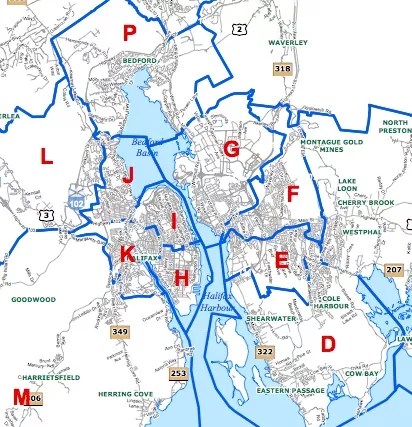
City staff is recommending that council adopt new electoral districts, modelled on those presented as “Scenario #1” to the public, but with revisions that have never been discussed publicly. See the full staff report here (very large PDF).
Readers will recall that the Utility and Review Board ordered council to reduce the number of council districts from 23 to 16. City staff then produced two different proposals for discussion, Scenario 1 and Scenario 2. I discussed these in some detail here. Staff then conducted a series of public meetings and two surveys for public input, then went off and drew up the present proposal.
My very quick review of the recommendation follows after the jump, but this is an immensely complicated proposal, and so I strongly urge readers to drill down into the maps and give their own opinions in the comments. I also want to reiterate that this is an extremely short timeline: staff is making the proposal public at 5pm on a Friday, with council voting Tuesday. There’s no way the maps can be adequately processed and discussed before Monday, which is the latest people can contact their councillors for feedback.
Now, to the details. First, urban representation has been slashed considerably, with peninsular Halifax districts going from four of 23, or 17 percent of the districts, to two of 16, or 12.5 percent of the districts. If you expand “urban” to include Fairview and Dartmouth Central, representation goes from the current 30 percent to a proposed 19 percent. In some circles, reducing the number of councillors was sold as a way to increase the voice of urban councillors lost in a sea of suburban councillors, but that was clearly a bogus argument from the start; there was never any hope that urban representation would increase through cutting the number of councillors, and this proposal demonstrates that fact.
As for the peninsular districts, there are two in the proposal: one north, one south. Councillors Jennifer Watts and Dawn Sloane reside within the northern district, presenting an interesting electoral line-up. (Jerry Blumenthal also lives in the new district, but he has announced he won’t be seeking reelection.) Sue Uteck is the only sitting councillor living in the proposed southern district.
In terms of “revisions,” the biggest and most profound changes from the Scenario 1 shown to the public and the proposal made public today are in Dartmouth. Scenario 1 had three Dartmouth districts: one roughly north of Lake Banook and Lake MicMac, stretching from the harbour out to beyond Burnside; a second middle district streching south to Portland Street and up along Mount Edward Road, going east to a thin wedge to the harbour and west to the Highway 107 extension; and a third district to the south, also stretching from the harbour to Forest Hill Parkway and Caldonia Road. The “revision,” however, ditches that arrangement entirely. There’s now a compact central district long the harbour, north to Woodland Avenue and with a eastern and southern boundary of the Circumferential Highway; a northern district now takes in the areas north of Woodland and Burnside, but then also stretches down east of the highway all the way to Main Street; the southern district then finishes the wrap around the central district.
The Dartmouth arrangement is odd. It splits the the Woodlawn area off of Main Street, which seems like a cohesive neighbourhood to me, and places it with Burnside, clear across town. This was a major sticking point some years ago at a previous UARB hearing, and it’s doubtful the neighbourhood will accept the arrangement without a fight. That said, the new arrangement does make more sense for my neighbourhood in downtown Dartmouth. Still, it’s a hell of a change to be pulling on people with no opportunity for feedback.
In terms of geographical changes, the biggest alterations from the Scenario 1 shown to the public and the proposal made public today are out in the rural areas. Scenario 1 had placed the Old Guysborough Road in a Fall River district; the revision puts it back in an Eastern Shore district that Steve Streatch now represents. That additional population is balanced by slicing the Seaforth/Grand Desert area off the Eastern Shore district and putting it in a Prestons district.
The change in the Fall River district solved one of the messier problems with Scenario 1. Scenario 1 had a Sackville district stretching all the way from Bedford to the Hants County line, with a population 31 percent greater than the average—generally speaking, the UARB frowns on any population variance between districts greater than 10 percent. The revision solves this problem by lopping off Upper Sackville and placing it together with Fall River.
Otherwise, the Scenario 1 lines look to have been mostly kept, with some tweaking between the Tantallon and Prospect districts in the area around Peggys Cove. I’m still making my way through the documents, so I welcome your comments and observations.
This article appears in Oct 13-19, 2011.
I too live in Downtown Dartmouth. I actually attended one of the public hearings and there was a fair bit of concern expressed regarding the line that the orignial Scenario 1 drew right down the middle of the Downtown neighbourhood. I’m glad to see this revision as I didn’t feel that having my neighbourhood cut in two was a good thing! (neither did you it would seem!)
The North Dartmouth – Waverly district is an odd one, but I can understand where staff were coming from. At 16 councillors, the old Scenario 2 Dartmouth District was amongst the largest of the hypothetical districts. The problem is urban Dartmouth isn’t quite big enough to support two districts. The population is like 1 and half districts. Something had to be added to make 2 districts. Staff did their best with a flawed setup. Had it been 18 councillors maybe the lines could have worked better. We went about this all wrong really. The question should have been what’s a reasonable number of residents per district and what are the community’s of interest that are important. Start from the ground up instead of having 16 dictated to HRM and then having to square the circle.
spaustin – Dartmouth is big enough for more than 2.4 districts, the population is/was 60,000
Joe – Sorry I guess what I meant wasn’t clear. The old City of Dartmouth had around 60,000, but it included suburban areas on the other side of the Circ like Woodside. Those areas contributed towards the old 60,000. What I was getting at is the population of North Dartmouth, combined with the Old Downtown isn’t quite enough for two districts with the new number of council seats. North Dartmouth’s residential neighbourhood has very well defined edges with Bedford, the harbour and highways. That means to make a North Dartmouth district, the only natural place to gather up more residents is to the south in Downtown. Staff tried that at first with the original Scenario 2, but it resulted in a very large Dartmouth District that didn’t capture Downtown’s community of interest. Essentially, North Dartmouth plus Downtown Dartmouth are, combined, a district and a half.
Unfortunately, the only way to make the population numbers work while respecting the community of interest is to lump North Dartmouth in with Montague/Caledonia and Waverly (3 united communities of interest in 1). That’s not a great fix, but there really doesn’t seem to be one since the alternative when heading south is to divide the Downtown. Better to have 3 united communities of interest in one strangely drawn district than to divide the Downtown. That’s why I was suggesting that maybe we should have figured out our communities of interest and how many residents per councillor is reasonable instead of having the URB just pick a number out of the air. We’re now getting a glimpse of what trying to square a random number to reality means. If we had 18 councillors instead of 16, maybe the numbers would work better!
Halifax has been a city since 1841. During that same year Joe Howe began his fight for responsible government and it is a point of pride in Halifax that in February 1848 Howe achieved his goal and brought responsible government to Halifax, to Nova Scotia, to Canada and to the Commonwealth.
How sad it is that now 170 years later, though the long dark work of an unelected and unaccountable bureaucracy, Halifax and it’s citizens no longer are free to govern themselves or set their own course for prosperity.
This is not good for the city or for Nova Scotia and I’m more clear than ever that the only way to resolve the issue is to demand that the regionalist amalgamated municipality be dissolved and returned to a more Localist form of local government.
It costs a lot to service the burbs and rural areas. The majority of tax profits after direct expenses to service the lot come from our downtowns, which will have a decreasing voice. Some stats from 5 year plan shows that development outside downtown is 11% above plan, and development in the core is 38% below plan.
Not only is the balance of political power already slowly draining our ability to invest in the community, but it’s going to get worse. We could hope that all councillors will see benefits of a strong downtown supporting their communities, but it’s their constituents who elect them, and unfortunately they tend to see downtown as the the place with everything, rather than the place that provides everything.
Maybe the answer is councillors at large. I found the system (with 10 at large councillors + Mayor) in Vancouver much more responsive and effective, and even in a much larger city with many fewer councillors, I would get a response to my emails, which I seldom do here.