


The north end community was rightly incensed by city council’s December 13 decision to sell the former St. Pat’s-Alexandra school site to developer Joe Metlege without first offering the school to neighbourhood community groups, as required by council policy.
In the face of that anger, council reversed the sale on January 10, and directed staff to bring back a report on what went wrong with the sale.
The staff report is now completed, and was released Friday as part of the agenda for this coming Tuesday’s council meeting.
It is a despicable document.
If the community was angry in December, they should be boiling mad now. And people not directly part of the north end community should likewise be disgusted that their government officials are engaging in a straight up racist attack on fellow citizens; the broader community should be just as indignant for what’s being done in their name.
The staff report epitomizes the faceless, bureaucratic false framing, misdirection and half-truths that is modern racism, so let’s put names and faces to it, and lift the curtain to reveal their bullshit.


The report was produced by people with an agenda. Everything in city hall is now micro-managed by the CAO’s office; nothing is initiated without chief bureaucrat Richard Butts’ approval, and nothing comes forward that he doesn’t personally vet and approve. This document, too, was approved by Butts and his lieutenant, deputy CAO Mike Lebrecque. They directed a fellow named Peter Stickings, who heads the city’s real estate department, to actually write the report.
I’m told that the St. Pat’s sale is part of a larger directive from Butts to Stickings to sell off as much land as quickly as possible in order to raise capital for construction of a stadium. This directive also threatens to derail the rebuilding of the former Bloomfield School site as a complex oriented around community uses.
The report starts with a startling admission that staff did not follow proper procedures related to the surplus St. Pat’s site. Indeed, council policy is that surplus schools must first be offered to community groups, who are to be given a reasonable opportunity to put together a business plan for using the school site; only if the community groups don’t want it or can’t make a good case for it is the property to be offered for sale on the open market. That didn’t happen in this case: community groups were not consulted and given time to put together proposals, but rather the property went directly to sale.
“This gap between Procedures for the Disposal of Surplus Schools and general practice,” reads the staff report, “has led to a level of dissatisfaction with respect to the process.”
No shit.
But this is no apology. Rather, the screw up is used as reason to double-down on breaking the policy: instead of adhering to the policy, going back and doing it right, the report attempts to (mis)lead councillors down a path where the only right decision is not to follow the policy, but to ditch it.
This is accomplished through what is portrayed as an objective analysis of the costs and benefits of either following the policy or not. We are provided flow charts, and options, and references to legal issues which will be discussed in secret Tuesday. But it all boils down to a (supposedly) dispassionate cost analysis:
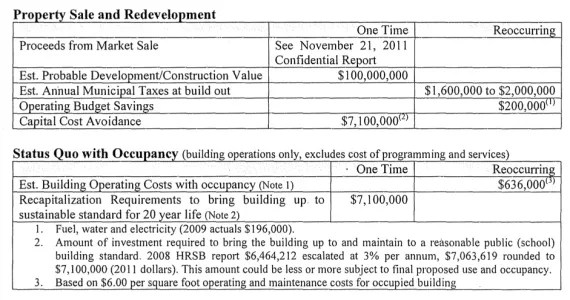
Got that? We could either do the policy right, and spend $7.1 million to fix up the school buildings, and then another $636,000 a year so the community organizations can use them OR we could sell the buildings for some secret amount, then Metlege will build $100 million worth of stuff on the site, we’ll get $2 million in property taxes each and every year, and we won’t have to spend $7.1 million to fix up the buildings or the $200,000 a year we’re spending now to maintain them.
Framed that way, the only responsible decision would be to break the policy and sell the property. That’s clearly what Butts wants council to do, albeit the report doesn’t actually make a recommendation–selling the school is the only fiscally prudent option.
But this is not a dispassionate analysis of costs and benefits. It’s loaded dice, a stacked deck, smoke, mirrors.
Let’s start with the either-or choice. It’s either one or the other, we’re told, but that’s not the case. Their are any number of other options: The community groups could make use of some of the property, and the rest of it could be sold off for development, for instance.
The bald lie in the above chart is that the only way the community groups could use the site is “status quo with occupancy.” In reality, the city’s own policy dictates that:
If there is sufficient interest expressed by a community group or groups, the Municipality may consider selling or leasing the building for local community purposes. Past experience indicates such groups do not have the financial means to either purchase or lease the property at market value, and therefore usually seek some form of assistance from the Municipality. Staff of the Community Grants and Partnering Program would review the applications and business plans submitted by such groups to determine an appropnate level of support from HRM, and make that recommendation to Council.
Clearly, the intent is to allow the groups to put together a business plan, and for that to be assessed by council. “Past experience” aside, we have three community groups—the North End Community Health Clinic, the Mi’kmaq Friendship Centre and the Richard Preston Centre for Excellence—with established, successful operations that are now paying rent elsewhere. At the very least, they’ll be able to to bring their existing rent payments to the school site. Additionally, the groups have a proven track record of being able to raise capital and operating costs from outside sources and other granting agencies—with enough time to pursue more funding, they very well could be put together a business plan that would reduce or eliminate the need for city subsidy.
The staff report, however, presupposes no outside funding, without giving the groups the opportunity to demonstrate otherwise, and then on the basis of that presupposition concludes that the groups should therefore not be given the opportunity to demonstrate otherwise.
But the most important false accounting in the chart is “Capital Cost Avoidance” of $7.1 million. That figure is arrived at by looking at the cost of refitting the school buildings. Ignored are the capital and other costs of not giving the community groups a new home.
The community groups’ buildings on Gottingen Street are ancient, and will soon need to be replaced, or the groups will have to pay for new homes elsewhere. What will that cost? Why isn’t that figure in the chart? Is this an admission by city staff that they have no intention of helping the groups continue to exist when it comes time to replace those buildings?
And what if the lack of a home means the community groups can no longer exist? What would be the dollar costs of losing them—the increased costs of health care and the costs of lost community supports in an impoverished neighbourhood, policing and the like?
Staff looks at the school site through the narrowest of all possible lens: the development of the school site will create $100 million of “Development/Construction value,” which in turn will produce $2 million in annual property taxes. The implication is that if this site isn’t developed, we’ll lose out on that $2 million every year, forever.
But that’s not how the world works. To a large degree—and especially in the over-heated real estate market that is the post-shipbuilding contract award north end—development is a game of whack-a-mole. If development can’t happen at site A, it’ll pop up over at site B. Metlege apparently has financing to build $100 million worth of stuff; he’ll use it somewhere, count on it.
In any event, an obscenely fawning Chronicle-Herald profile of Metlege suggests that he has no plan to immediately develop the site anyway. He first will oversee the reconstruction of Fenwick Tower, which won’t be complete until at best 2016, then will move on to the development of the former Trinity Church site at Brunswick and Cogswell Streets which will take, what, another five years? Only then will Metlege turn his attention to the St. Pat’s-Alexandra site.
Undoubtedly, once the school sale is complete, Metlege will immediately raze the buildings and put a fence around the empty lot. And there it will sit, for at least a decade, an eyesore in the heart of community that has enough eyesores already. What will be the costs of that? How much will nearby property assessments, and therefore property tax returns, be reduced? What are the social costs of having yet another abandoned construction site in our city? Why aren’t those costs on the chart?
The community groups aside, developers work on thin margins, and make money on finding under-priced property to exploit; that Metlege can buy the property and let it sit empty for a decade tells me that the city sold it for a song. Perhaps the under-priced sale value should also be included on staff’s chart.
There’s an unspoken premise behind the staff report: The existing neighbourhood does not matter. If there’s immediate money to be made, well, screw the community. And this is why the staff report is at its heart racist. Is it even conceivable that, say, the concerns of residents of the south end or the Shore Drive in Bedford, would be reduced to such a slanted monetary analysis? No. But residents of the north end are expendable.
In reality, selling the school only makes financial sense if you prevent an option that doesn’t fit the false framing from being heard, ignore all the subsequent future social costs and lost opportunity costs of providing a home for the community groups, and instead look only at the immediate return to just the capital fund in the city budget.
Losing community groups in an urban poor neighbourhood has lots of other costs that I haven’t mentioned—the increased transit costs to provide transportation for the working poor pushed off the peninsula, and the higher wage costs to downtown businesses, for example—but the biggest cost of all is the incalculable human costs to people alienated from their government, losing the social networks and supports built up over decades, and displaced from their homes because the wider city doesn’t care.
Related Stories

St. Pat’s-Alexandra sale goes to court

Jono not interested in St. Pat’s mediation
This article appears in Jan 19-25, 2012.

Tim, there is only one taxpayer. No matter how you slice it, the community groups you support still are taking their funding out of the public purse.
The policy says HRM “may consider” selling property to community groups. It does not say “shall sell”.
Your comments on the development process are simply laughable and do not deserve further comment, except to say that sites are not out there for the taking like pebbles on the beach. There is no benefit to the citizenry from leaving a derelict building in place.
Hopefully council makes this right, cleans up the policy, and sells this thing as originally intended.
Public funding usually amounts to only a portion of the revenues raised by non-profits to sustain the services they provide. Any successful non-profit society or Co-Op will have a diverse fund development plan that will include community engagement, private donors, and corporate sponsors.
Tim, your hatred and slanted views are pathetic at best, clearly the coast is a rascist, biased, gossip journal as opposed to a news group. The bottom line is everyone put in a bid and all were evaluated.. if the groups can come up with the $7 million to fix up the bulding and the $700,000 a year to operate it, why dont these non-profits put that into providing programing and additional services, as opposed to holding up progress and densification. not to mention taking away the $2millions a year the property taxs paid would help offset much more concerns and positivly impact all halgonians as opposed to your select favored ones..
wake up and thank the developer for trying to improve this part of town, and don’t attack a local business person for the mistakes of others..
If it was a call center, or some out of town company that wanted to spend $100 million in the local economy the city NSBI and ACOA would roll out the red carpet and through millions of dollars to them to try and attract them, but because this developer happens to be in the business of development and not cheap labor exploitation you seem fit to attack.. grow up and get your facts stright…
I’ve got yet another take on this entire matter. Schools like St Pat’s Alexandra were built during an architecturally bankrupt phase of public building construction. This school I believe was built in 1971; the city built a shitload of butt-ugly, prison-looking, unhealthy schools back in that timeframe. I remember how in elementary we had to move out of my old-style brick school (big windows for natural light, not many kids getting asthma in *that* building) into temporary classrooms, only so that in Grade 6 I finished off my elementary in a box penal building that needed lights on all the time because the windows were these tiny medieval slits, and that needed permanent A/C because the goddamned structure was practically hermetically sealed.
“Open the windows for fresh air on a nice spring day?” “Uhhhhhh……we’re not able to do that, really, the room only has one little window.”
St Pat’s Alexandra isn’t as bad as some, but it’s still an ugly and probably unhealthy building. I think we’d be better off jumping at the opportunity to demolish these aberrations when such opportunities arise.
I don’t know what the perfect solution is here. I understand that Metlege is not averse to working with non-profit groups, and the city should be willing to work with Metlege and those groups to see what can be made to happen. I seriously distrust city staff so I believe the leadership will have to come from council….which realistically means we’re f**ked anyway. But one can hope.
I doubt that the three non-profit groups who routinely get called out in relation to this issue actually give a shit as to what facility they are in, or even that it’s on that lot, provided that sometime soon, however it happens, they are in reasonably decent spaces somewhere in that neighbourhood. It’s disingenuous to insist that they have to be in a refurbished re-purposed St Pat’s Alexandra building. Like I state above, we’d all be happier if that piece of shit was torn down, and something better (in every way) erected in its place. While we’re at it, Bloomfield is equally a ugly piece of shit, and I’d like to see that torn down too. At least we have seen QEH demolished – it’s a start.
On the bigger issue, that of community identity, let’s not forget that there isn’t all that much attractive about that particular community that we should be falling all over ourselves to preserve it. This is not racism nor is it elitism. It is *not* going to turn into a prosperous, reasonably safe, and vibrant district except through a gentrification process. Accept that, it’s the hard truth. If you want to leave it as a low-rent area, at least acknowledge that.
When will Butts be taking up residence in HRM ? He gets paid here and files his tax return as an Ontario resident. Does he have a young family back in Toronto ?
HRM should scrap the community centre at Bloomfield and move it to St Pats/Alexandra. The land at Bloomfield has much more attractive development potential. HRM needs to put in place a deadline for commencement and completion of construction on the properties they sell. Too many developers are buying, demolishing and sitting pat.
Even more important is the agenda item 10.2.1 http://www.halifax.ca/council/agendasc/doc… whereby Butts et al seek to shut out public discussion of the planning review and hand it over to Don Mills and other cronies under the guise of ‘Strategic Urban Plan’ and they will decide how and when the public is consulted.
JB, you might want to ask the tenants of the Bloomfield Centre how many of them would like to move to St Pat’s Alexandra. Just a candid, off-the-record poll.
Sure, all the Bloomfield tenants seem to be making the right solidarity noises with respect to the other place, but I’d be real curious as to how far that solidarity extends. Maitland Street is an area where roughly 99 percent of HRM’s population wouldn’t be caught walking after dark…and at least 50 percent wouldn’t walk there in broad daylight.
It’s a nice thought though.
Really strange how the focus of this cock up always focuses on the “Poor disadvantaged, minority(black-native) point of view). Little or no concern seems to be evident for the taxpayers who must carry the freight, while the groups involved inherit this paid in advance proposition. Having a person with a bull horn does not pay the bills, she comes from an organization that like all of the other religious groups parasite on the populace,while they live in splendore enjoying a tax free existence . It is laughable that the author of this piece can just pass over figures in the high millions as if they were petty cash, in favour of abstract outcomes as they affect the lives of those effected directly. Be mindful that the country the province, the city provide this community with clean, safe,affordable housing, as well as a myriad of other services, in most cases nothing is paid back in return, quite unlike hard working people who pay the taxes so that this group can sing the blues because they feel that they are not getting enough, well they will never get enough, fill every want and need and that will never be enough. The simple reason being that what you acquire by no effort possesses no value, objects that have no value are deemed to be disposable, disposable items just end up littering our city,which in the end has to be cleaned up at great .expense,but that cost is paid by others, not the participants of this saga, the saying put your money where your mouth is rings true, your money not others hard earned cash, so that you can profit t until the next want surfaces.
Once again, staff continues to advise against policy, rather than simply advising to now follow it. In what seems like a deceptive manner, staff confusingly offers the option to “Keep and Follow” the policy (option B) and yet, when describing this option, indicates that this decision would task the Grants committee to review the previously submitted RFP submissions. These original submissions were drafted in haste by organisations that had not received the 90 days notice or been included in public consultations as detailed in the policy and therefore do not represent the full potential of their proposals. On the other hand, the report’s option C proposes to invite all community interests to submit new proposals for recommendation, which is the proper way to begin the process anew according to the policy. However, this same option (C), also includes the repeal of the policy pitting the community submissions once again against private sale submissions, thus repeating a similar process as the one already undergone against policy. Since the other two options (A & D) include the repeal of the policy, this clearly means that no options offered by staff in their report allow council to follow city policy. Once again, council is being led by staff to break its own policies and to put itself in a position where legal action is due.
Attention Tax payers..
found this petition, everyone should sign it
http://www.ipetitions.com/petition/sell-st…
the property has been sold to the developers
Well, City Council has finally been manipulated by the city’s senior
bureaucrats into an action that will surely result in a lawsuit by either the community group or the developer. What will that cost the taxpayer ? Well done !!!!
What’s wrong with following the process set out by the policy ? …..so they didn’t do it right the first time, so go back and do it right this time, give the community groups their 90 days…give Jono Development their $300,000 back.. provide Councillors with full disclosure of the bidding and selection process, have a vote and live with the result. At that point dis-satisfied members of the community can show their dissatisfaction at the polls.
Tuesday nights have turned into a gong show…..moderated by CAO Butts and his senior bureaucratic co-horts. Council is consistently bullied into making decisions based on insufficient or tainted information. We can’t expect our elected officials to make good decisions without sufficient information and CAO Butts is controlling the information they get….. there are some hardworking, conscientious individuals on City Council, but they can’t work without the appropriate tools. ” Information” is one of the tools of democracy that our elected officials need to make informed decisions.
The St Pat’s/Alexandra school fiasco is just one more symptom of the disease that’s running rampant on our City Council. The first step should be to revise the City Charter and take the power out of the hands of the bureaucrats and put it back into the hands of our elected officials !!! That’s how government and democracy is supposed to work.Then, if we don’t like the job they’re doing we can exercise our democratic right and replace them come election time. Unfortunately, for that to happen we’d need a Mayor with not only leadership ability but some intestinal fortitude as well.
As it stands now, a large number of our Councillors may well lose their jobs in the election this fall and I don’t think its entirely their fault. With the City Charter the way it is and a contol freak as CAO, a whole new slate of Councillors won’t leave the city any better off.
For sale one used mega phone, it talks really loud, but like a lot of the items you can buy today it is only as good as the person using it.The mouth piece is slightly damaged cause by overuse. Call Britten or drop by, either way take your wallet, we need money and lots of it.