


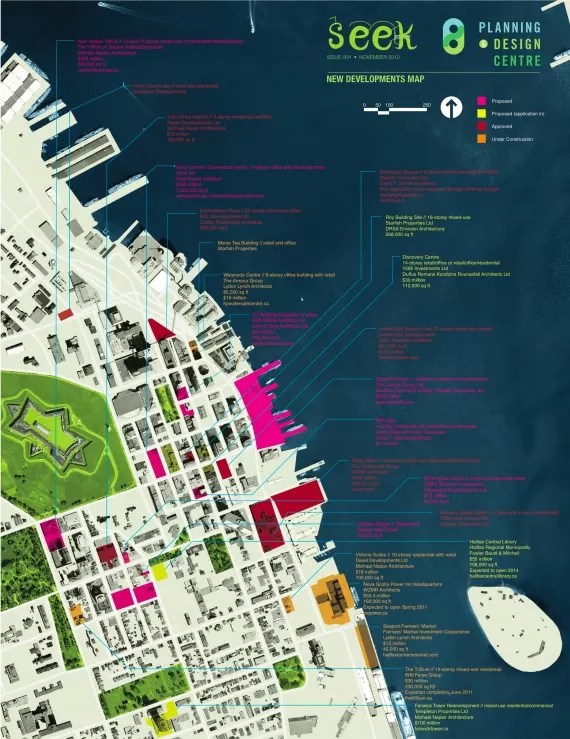
The Dalhousie Planning and Design Centre has produced the above map of downtown, detailing 23 development projects—all proposed and approved, some built, some still awaiting construction, but most just a distant dream—which was in turn sent to me by Paul MacKinnon of the Downtown Halifax Business Commission.
“Developers are buying and assembling land, hiring architects, and working their way through the approval system,” writes MacKinnon. “Despite this, as you will note, most of these projects are not yet underway. Many, it is conjectured, will not happen for years, if ever.”
See a full-size version of the map at the last page, here (very large PDF).
Most interesting is the PDC’s analysis of the potential tax benefits of these developments. “If all of these developments were to be built,” writes MacKinnon, “HRM would collect an additional $27 to $39 million each and every year in municipal taxes. At the same time, since these projects are in the downtown core, additional servicing costs would be negligible—transit, fire, police, streets, etc., are all already here. HRM is dependent on increased property tax revenues. High density development in already serviced areas, such as the downtown, is the most profitable development for HRM, and for dealing with the budget shortfall.”
You can find PDC’s methodology and more details at the above link.
People will have different reactions to this map. I called MacKinnon to follow up on his email, and he suggested various government policies to further streamline the development application process and reduce fees by, for example, exempting downtown developments from application fees. He sends along some downtown development strategies that London, Ontario have employed to great success—see them here, especially page 10.
I’m not opposed to such suggestions, but I’d note that even the Chamber of Commerce says that the city has done an excellent job in recent years in reducing the paperwork and time delays associated with development, and I really think it unlikely that the paperwork fees is making a difference between building and not building—after all, developers have already sunk hundreds of thousands of dollars into their proposals, so a few tens of thousand more isn’t going to be the make or break point.
But, like I said, I’m not opposed to such ideas, and especially not if they’re made revenue neutral by increasing fees for developments outside the downtown, which likewise might have some small effect in steering more development to the urban core.
I have to say, my first reaction to this map was, “can we now put an end to the ‘Heritage Trust keeps downtown in the 19th century’ nonsense?”—clearly, as these developments have all been approved, it is the developers themselves, not Heritage Trust, that is stopping the buildings from getting built. I’m ambivalent about Heritage Trust—they seem often to needlessly embroil public opinion against themselves, and have been criticized for not working to actually preserve heritage buildings, like with the Khyber building. But a heritage preservation advocacy group is an important part of any city, in my opinion.
Regardless, for me this map illustrates that there are larger economic issues at work affecting development potential downtown. Real estate consultant Mike Turner has written about these forces in great detail. I don’t think there are any quick and easy solutions to these problems, but I’m liking Bernard Smith’s suggestion that a lower tax rate apply downtown (Smith was former president of the Spring Garden Area Merchants Association). I could envision small annual reductions in the property tax, with the lost revenue offset by increases in the tax rate in suburban business parks. This, incidentally, is how I think the ill-fated “tax reform” effort should have proceeded—don’t muck around with bizarrely complicated and socially regressive fee-for-service plans; just change the overall tax rates in certain areas to steer development where you want it.
Anyway, I just wanted to throw this out there for discussion.
This article appears in Jan 6-12, 2011.
Shove it under the nose of Val Payn and her loons at the Chamber of Commerce and see what she says.
And then ask her to comment on the Turner report which said office rents are not high enough to support new office towers.
Even if all the projects were built who would use them.
HRM staff and council happily approve large office projects in Dartmouth Crossing and then wonder why office projects are stalled downtown. The last office projects of any note were RIM in Bedford and a MacRea project in Burnside.
Do the math and you will quickly realise a break on tax rates will not make new construction viable. The only answer to the viability problem is the ‘Ramia Doctrine’ – the developer builds and then leases a public facilty to a governmental agency and uses the rent to subsidise the losses on the private facility.
No one is against development of any kind. God knows Nova Scotia needs development, but, fortunately or unfortunately, it’s the 21st century. Whatever develops better be sustainable and better not contribute to environmental degradation or to detriment of quality of life ( such as it is ). I’m afraid what people sometimes propose is hardly contributing to the city’s overall betterment either in terms of environment or quality of life. There’s a lot of post modern dead tech out there.
Hey Joeblow, the Ramia Doctrine ? Ever hear of a guy named Ralph Medjuk ? It doesn’t make any sense to make subsidies to private developers. It didn’t make sense in the past and it doesn’t make sense today. Development has to be sustainable. Subsidies are unsustainable.
gmo – You missed my sarcasm.
The problem is a glut of cheap land in awful places like Dartmouth Crossing and Bayers Lake. Enact greenbelt legislation like in Ontario and BC and force developers to invest closer to town.
“can we now put an end to the ‘Heritage Trust keeps downtown in the 19th century’ nonsense?”
No we can’t.
I think the real reason all of these developments are in limbo is BECAUSE of the Heritage Trust.
Their rural fantasy, comined with a serious NIMBY slant, means these developers, using their own private money to get these projects off the ground, are instead stuck in legal limbo and government red-tape, and hiring lawyers to do the city a favor.
I wouldn’t want to develop anything in this shit hole – I’d move to a real city where you can build a 7 storey building and it isn’t coined “an office tower” along with all of the other demonized crap people at the trust can drum up in their small little minds.
Hardly surprising that the Coasts staff communist, Tim Bosquet, wouldn’t be able to grasp the economics of real development, or how obstructionists like them are killing this city.
The only way to grow is up, not out, and it is the only way to save this city from itself (and retarded interest groups like the trust).
Bedford West and all the other suburban crap happening in this city, at significant cost to public services, is not the answer, though they get record speed approval – why?
Because the Heritage Trust is a supporter of massively scaled urban sprawl, and not ecologically sensible, fiscally sound urban intensification/densification.
They are killing our city and I won’t put up with their nonsense anymore. I’m not the only one. THAT is why the tide of public opinion have turned against them. Most people get it. Just not the Trust, and certainly not Tim Bousqet.
One reason why some developments were stalled was the lack of financing available during the recession. Heritage groups did add to this problem by delaying many developments proposed in good economic times until the recession.
Something else that should be pointed out is that it was always very obvious that there wasn’t demand for half a dozen new office towers downtown. Halifax is already getting one big new office building (Emera) which will open up new space in Scotia Square.
The best development for the downtown right now is residential but unfortunately we aren’t seeing it, perhaps because of the preference for commercial which might be encouraged by zoning. One of the big distinctions between relatively successful Spring Garden and Barrington is that Spring Garden Road has far more residents nearby.
Finally, it’s important to have a sense of perspective. The media in Halifax might be very negative but the fact is that there is tons of construction occurring on the peninsula right now and more projects are going to start up in the spring.